|
 |
 |
 |
 |
 |
 |
 |
 |

 |
Boeing Tests Two-Pound Imaging Radar Aboard ScanEagle Unmanned Aircraft
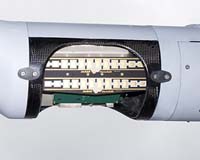
St. Louis MO (SPX) Mar 25, 2008 Boeing, in partnership with ImSAR and Insitu, has successfully flight-tested NanoSAR, the world's smallest Synthetic Aperture Radar (SAR), aboard the ScanEagle unmanned aircraft (UA). During the 1.5-hour flight on Jan. 7 at the Boardman, Ore. test range, ScanEagle, with ImSAR's NanoSAR payload installed, completed several passes over the target area at various altitudes and ranges. The targets included vehicles, structures and corner reflectors. Data collection onboard the ScanEagle worked as planned, and SAR imagery was later created on the ground. The next step in flight testing will be to create imagery aboard the UA in real time. The NanoSAR is a 2-pound system approximately the size of a shoebox. The weight of standard SARs ranges from 50 to 200 pounds. "In the past, the advantages of SARs' all-weather imaging capabilities have been the exclusive domain of only larger unmanned aircraft. Now, even the 40-pound ScanEagle can carry both an electro-optical or infrared camera and a SAR payload at the same time," said Carol Wilke, ScanEagle chief engineer for Boeing. "SAR is now at the lower end of payload weight budgets instead of at the top. "The NanoSAR technology's ability to see in hazy, cloudy, rainy or foggy conditions is ideally suited for the maritime environment," Wilke added. "Combined with ScanEagle's long-endurance capability, NanoSAR offers a cost-effective solution for customers' surveillance requirements." Logan Harris, chief technology officer for ImSAR, said, "SAR is the best tool to get certain jobs done, such as finding small vessels on the ocean. But because of the size, weight, power and cost of SAR systems, it just hasn't been possible to get this capability to the warfighter on a broader scale. NanoSAR has changed that. The NanoSAR is built on Printed Circuit Board technology that is rugged and can be rapidly and cost-effectively manufactured." Since 2004, the ScanEagle system has proven on a daily basis that it is the best-value solution to support warfighters in the field around the world. It has logged more than 70,000 combat flight hours with the U.S Marines Expeditionary Force, the U.S. Navy and the Australia Defense Force in Iraq and Afghanistan. The Navy has logged more than 900 shipboard recoveries using ScanEagle. ScanEagle, a joint effort of Boeing Advanced Systems' Advanced Precision Engagement and Mobility Systems and Insitu, was developed as a low-cost, long-endurance autonomous unmanned aircraft to provide persistent intelligence, surveillance and reconnaissance as well as flexible, rapid deployment for a variety of government and civilian applications. A ScanEagle UA carries inertially stabilized electro-optical and infrared cameras. The gimbaled cameras allow the operator to easily track both stationary and moving targets. Capable of flying above 16,000 feet and loitering over the battlefield for more than 24 hours, the platform provides persistent low-altitude reconnaissance. ScanEagle is launched autonomously via a pneumatic SuperWedge catapult launcher and flies pre-programmed or operator-initiated missions. An Insitu-patented SkyHook system is used for retrieval -- the aircraft catches a rope suspended from a 50-foot-high tower. The patented system makes the ScanEagle system runway-independent, with a small footprint similar to that needed for vertical takeoff and landing vehicles. Community Email This Article Comment On This Article Related Links www.imsar.com UAV News - Suppliers and Technology
 Pakistan test-flies pilotless plane: military
 Islamabad (AFP) March 20, 2008
Pakistan on Thursday conducted a successful test flight of a pilotless plane, the military announced. |
|
|

| The content herein, unless otherwise known to be public domain, are Copyright 1995-2007 - SpaceDaily.AFP and UPI Wire Stories are copyright Agence France-Presse and United Press International. ESA Portal Reports are copyright European Space Agency. All NASA sourced material is public domain. Additional copyrights may apply in whole or part to other bona fide parties. Advertising does not imply endorsement,agreement or approval of any opinions, statements or information provided by SpaceDaily on any Web page published or hosted by SpaceDaily. Privacy Statement |