
 |
 |
 |
 |
 |
 |
 |
 |
 |

 |
New Boeing Mission Control Center Opens
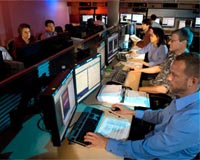
St. Louis MO (SPX) Aug 05, 2008 Boeing has announced the completion of a $10 million, 20,500-square-foot satellite Mission Control Center (MCC) in El Segundo, Calif. The MCC can manage up to four commercial or government satellite missions at the same time. The MCC replaces another Boeing facility in El Segundo that was smaller and had limited capacity. "The MCC is an integral part of our customer service and support operations," said Craig Cooning, vice president and general manager of Space and Intelligence Systems, a division of Boeing Network and Space Systems. "Our satellite mission experts at the center monitor the health of a spacecraft from the time it is mated to the launch vehicle through in-orbit testing. Over the past 26 years, more than 120 missions have been operated at Boeing MCCs, and we continue to invest in this service so that we are prepared to support any customer -- commercial, civil or government." The U.S. Air Force is expected to be the first customer of the new center and will use it to manage an element of the military's Wideband Global SATCOM (WGS) mission. Boeing has a long history of proven performance for the Air Force and is currently manufacturing satellites for the WGS mission, the Global Positioning System and the Space-Based Space Surveillance system. A Boeing-led team is also competing to build the Transformational Satellite Communications System (TSAT) Space Segment, which will provide military users with proven networked packet-switching technology for breakthrough mobile communications. Boeing's Team TSAT, which includes Cisco Systems, Hughes, IBM, Harris Corp., Ball Aerospace and Technologies Corp., LGS Innovations, Raytheon, General Dynamics C4S, L-3 Communications, BBN Technologies, EMS Technologies and SAIC, is under contract for the TSAT risk reduction and system demonstration phase. The Air Force is expected to announce the winner of the multibillion-dollar TSAT Space Segment contract later this year. The new MCC is located next to Boeing's satellite factory and features more than 100 engineering workstations that will be used for satellite operations. From these consoles, satellite operators and other experts can monitor a satellite's health and safety, conduct satellite maneuvers for placement into proper orbit, send software updates and provide other support throughout the life of the spacecraft. Boeing has developed a new computer network architecture for the center's four control suites that allows engineers to change the configuration from one unique mission to another in as little as a few days. At the old center, such reconfigurations would have taken much longer. The new MCC was designed with the flexibility to add additional control suites to respond to market needs. Community Email This Article Comment On This Article Share This Article With Planet Earth
Related Links Boeing Integrated Defense Systems The latest information about the Commercial Satellite Industry
 GMV Announces Strong Organic Growth In 2007
 Rockville MD (SPX) Jul 29, 2008
GMV has experienced strong organic growth in 2007. GMV saw a 17 percent increase in overall revenue, up to $106 million. Space and defense is the largest business area in the company. |
|
|

| The content herein, unless otherwise known to be public domain, are Copyright 1995-2007 - SpaceDaily.AFP and UPI Wire Stories are copyright Agence France-Presse and United Press International. ESA Portal Reports are copyright European Space Agency. All NASA sourced material is public domain. Additional copyrights may apply in whole or part to other bona fide parties. Advertising does not imply endorsement,agreement or approval of any opinions, statements or information provided by SpaceDaily on any Web page published or hosted by SpaceDaily. Privacy Statement |
 del.icio.us
 Digg
Digg Reddit
 YahooMyWeb
 Google
 Facebook