|
 |
 |
 |
 |
 |
 |
 |
 |

 |
Boeing Helps NASA Assess Shuttle Damage
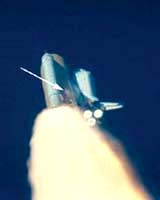
Washington DC (UPI) Sep 2, 2004 When the shuttle Discovery again blasts off into space, as it is scheduled to do next spring, astronauts on board will be flying new equipment that will make it easier to see if any of the winged ship's heat shield tiles or wing leading edge carbon panels have been damaged during the launch. A hole ripped into the leading edge of Columbia's left wing by falling foam during take-off in January 2003 is thought to have caused the craft's destruction. The damage-assessment equipment and new cameras are among several steps being taken before the return of the shuttles to flight -- a NASA task shared by the Boeing Co., builder of the shuttle fleet. Steve Oswald, Boeing's vice-president and manager of the company's shuttle program office in Houston, said Discovery will spend much of its initial return-to-flight mission assessing how well it endured the rocket ride to orbit. We're involved ... because we're part of the greater, NASA-space shuttle culture, Oswald told United Press International. He said Boeing will be reviewing the performance of the repair effort on the shuttle's thermal protection system and reinforced carbon-carbon wing edges. We're involved in that and also debris trajectory and the tolerance of the orbiter to take debris hits of various kinds. We've been involved technically and culturally, he explained. We're calling it hardening of the orbiter. The team was looking at ways to get more durability into the shuttle's heat-protecting tiles, and ways to strengthen the carbon to take a hit from falling debris. If you wanted to protect against a large, Columbia-type mass of foam coming off, Oswald said, one of the things you'd want to do is strengthen the RCC acreage by putting doublers behind it. The doublers would be reinforcements behind the tile, much like when construction workers apply wood braces behind a wall in a house. It won't be available for Discovery -- maybe not for the next 10 missions, or maybe never -- but we are looking at that, he added. Oswald said Boeing and NASA are looking at strengthening the craft's main landing gear doors as another precaution against damage. If you were to take a hit on the door leading edge, it is possible to end up degrading your margin, he said. So we are looking at redesigning that area. Oswald explained the main focus is to minimize the size of falling foam that could strike the climbing shuttle during lift-off. "What we need to do as a shuttle community is ensure that we don't end up having pieces of foam or metallic pieces coming off ... or a piece of stiffer insulation, or whatever. We're trying to make sure that this stuff stays where it's supposed to be, instead of coming off and hitting the orbiter. So we agree with NASA that the primary way to get back to flying is to eliminate the debris source and ensure that we can inspect and if we can repair any damage that does end up happening to the orbiter, Oswald explained. The new inspection systems are, in his words, a backup. It's a sort of belts-and-suspenders approach. Everything we're doing in terms of inspection and repair is backup to our efforts to ensure the foam stays on the tank, he said. But until we end up getting some experience with the foam and tank performance, we're going to need to inspect. Oswald said as a result of the uncertainty over potential damage, engineers are embedding new sensors into the shuttle's skin. We'll end up needing to do some things, like instrumenting the leading edge of the wings, so we're putting sensors behind the leading edge of the wing that would hopefully enable us to know if we were hit by something, regardless of what it was, he said. But we need to fly a couple of flights and that's one of the reasons we're calling the Discovery mission and the flight after it test flights, because we've never flown these sensors before. Oswald said NASA needs to establish a standard for the kinds of readings the sensors should generate during the pounding of the shuttle's blast-off. We don't know what the background noise is on a normal flight uphill, he explained. If you can imagine all of the rumble you get during first stage, with the (solid-fuel booster rockets) firing, it is during first stage that you'd expect any debris to come off, trying to determine if you got hit by a half pound piece of foam amidst all that noise is a challenge. NASA and Boeing also are working on a beefed up camera system, a better way of recording what the tank looks like as it separates from the orbiter. Again, it's very much a backup approach, but the primary fix is to fix the foam, Oswald said. To help the search for damage, a new sensor system will ride a boom that literally will wave across the shuttle's exterior, looking for damaged tiles or wing leading edge hits. The boom is made by the Canadians, Oswald said. It's the same guys who made the (robot) arm on the shuttle. NASA made the sensor package the new boom carries, however. Oswald said Boeing's role is to ensure the boom can be installed in the shuttle payload bay and handle the stresses during launch and landing. To do that, Boeing redesigned the mounting fixtures along the side of the shuttle in its open bay, where the new boom-and-sensor system will ride into space. The shuttle's robot arm, mounted on the opposite side of the bay, will be used to grapple the boom and raise it up above the spacecraft and then move it around above the wings and surface area to look for possible damage. It will be used in conjunction with the arm, Oswald explained. The challenge is that no such device has ever been flown before on a manned spacecraft. NASA is not only working to develop procedures for the Discovery crew to use in operating the device, but also is devising new programs to train both astronauts and flight controllers. Information from the sensors will be transmitted both to the crew inside the Discovery as well as controllers on the ground. You don't really need the boom to inspect some parts of the left wing, or underside of the vehicle, Oswald said. We needed to have the boom to inspect the starboard wing as well and the aft portions of the underside of the vehicle. With all of the new sensors and equipment flying into space aboard Discovery, Oswald is concerned about expectations for a perfect launch with no damage at all. He called that unrealistic. One of the things that has me a little bit concerned, as we go forward, is that the expectation of the public and the media is going to be that we have zero debris coming off the tank, and that we have zero impacts to the tile, he said. I don't think that anybody in our community thinks that is a realistic expectation. I think we're going to end up having some very small amounts of foam that are going to pop off the tank. And may end up chipping a tile. Such minor damage has happened on virtually every shuttle trip into space, he noted. We end up having several dozens to several hundreds of tile that we need to replace after every flight, Oswald continued. Because they end up being dinged by something. We always have tremendous amounts of margin, but when we return to flight, and we get Discovery back on the ground I think we're going to se some dinged tiles, just as we always have. He said the public needs to understand this. We need to educate the public that 'that's OK.' That amount of stuff is going to continue to happen, and it's fine, and we can operate safely with some small amount of debris. Oswald said the new Discovery will be the safest vehicle we've ever flown, but it won't be perfect and, by the way, neither is any replacement vehicle that's going to be built later. After all, he added, Perfection is tough. Next: NASA's leader says what it will take to fix the shuttle is a new attitude. Community Email This Article Comment On This Article Related Links SpaceDaily Search SpaceDaily Subscribe To SpaceDaily Express Space Tourism, Space Transport and Space Exploration News
 NASA Refines Design For Crew Exploration Vehicle
 Washington DC (SPX) Jan 12, 2006
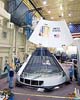
NASA's Constellation Program is making progress toward selecting a prime contractor to design, develop and build the Crew Exploration Vehicle (CEV), America's first new human spacecraft in 30 years. |
|
|

| The content herein, unless otherwise known to be public domain, are Copyright 1995-2006 - SpaceDaily.AFP and UPI Wire Stories are copyright Agence France-Presse and United Press International. ESA PortalReports are copyright European Space Agency. All NASA sourced material is public domain. Additionalcopyrights may apply in whole or part to other bona fide parties. Advertising does not imply endorsement,agreement or approval of any opinions, statements or information provided by SpaceDaily on any Web page published or hosted by SpaceDaily. Privacy Statement |