|
 |
 |
 |
 |
 |
 |
 |
 |

 |
Boeing Fires Up Engine in Preparation for Delta IV Debut
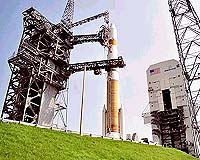
St. Louis - Oct 15, 2002 Boeing has completed a critical hot-fire rehearsal today at Cape Canaveral Air Force Station, Fla. The test sets the stage for the first flight of the Boeing Delta IV powered by the first U.S.-designed and built liquid-fueled rocket engine certified for flight in a generation. The test firing of the Delta IV first stage propulsion system - the Boeing Rocketdyne RS-68 engine - was an integral part of a second launch dress rehearsal designed to help ensure the success of the rocket's first flight-currently scheduled for mid-November. It was also the last major Delta IV development milestone for the rocket that was built by Boeing Integrated Defense Systems, a business unit of Boeing. "We are about to launch a new family of rockets that will have a long-term impact on the space launch, telecommunications and defense industries," said Dan Collins, vice president and Delta program manager. "Our team did a fantastic job of completing this rehearsal. The test firing serves as a steppingstone and positions us to obtain our goal of providing the U.S. government and the commercial world the best value, performance-driven launch vehicle for satellite deployment. "We planned a rigorous test program focused on assuring mission success and we've completed every test in the plan. Now it's time to go launch." During the rehearsal, the Delta team counted down to T minus 3.5 seconds, ignited the RS-68 main engine, and brought it up to full thrust at 17 million horsepower-rivaling the power generated by 11 Hoover Dams. The engine was shut off at T zero as planned. The Delta IV Medium+ (4,2), which includes a 4-meter diameter fairing with two strap-on solid rocket motors to supplement the first stage engine, is scheduled to launch next month from Space Launch Complex 37B. It will deploy into orbit the W-5 telecommunications satellite for Eutelsat S.A. of France. The Delta IV Medium+ (4,2) is one of five Delta IV configurations. The largest and most powerful of this launch system is the Delta IV Heavy, which can carry up to 13,130 kg (28,950 lb) to the geosynchronous transfer orbit (high orbit). The new Delta IV launch system was developed under the U.S. Air Force's space launch program called Evolved Expendable Launch Vehicle (EELV) to reduce launch costs and provide assured access to space. Though an Air Force program, EELV was designed with both government and commercial use in mind. Community Email This Article Comment On This Article Related Links Boeing SpaceDaily Search SpaceDaily Subscribe To SpaceDaily Express Rocket Science News at Space-Travel.Com
 Falcon 1 To Launch February 8
 Kwajalein Atoll, Marshall Islands (SPX) Jan 11, 2006
The new launch time for Space X's maiden launch of its Falcon 1 rocket is February 8, at 4:30 p.m. California time, with Feb. 9 as a backup day. We will actually be ready to launch earlier, but are planning to spend extra time reviewing and double-checking all vehicle systems. |
|
|

| The content herein, unless otherwise known to be public domain, are Copyright 1995-2006 - SpaceDaily.AFP and UPI Wire Stories are copyright Agence France-Presse and United Press International. ESA PortalReports are copyright European Space Agency. All NASA sourced material is public domain. Additionalcopyrights may apply in whole or part to other bona fide parties. Advertising does not imply endorsement,agreement or approval of any opinions, statements or information provided by SpaceDaily on any Web page published or hosted by SpaceDaily. Privacy Statement |