|
 |
 |
 |
 |
 |
 |
 |
 |

 |
Boeing Establishes Orbital Space Program Office
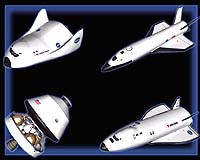
St. Louis - Nov 04, 2003 Boeing has established an integrated Orbital Space Program office today, headquartered in Huntsville, Ala. That will provide innovative solutions for NASA and support a robust future for human space flight. The Boeing Orbital Space Program office includes the Orbital Space Plane (OSP) and Alternate Access to Station (AAS) programs. The Orbital Space Program offers a synergistic approach to developing an integrated architecture sustaining the International Space Station and providing a foundation for the extension of human space flight beyond low Earth orbit. Boeing has designed and produced almost every major human spacecraft for NASA. "We will provide best of industry solutions in support of both Orbital Space Plane and Assured Access to Station," said Mike Mott, vice president, NASA Systems, for Boeing. "Our goal by combining these programs under a single, integrated program office is to benefit from their inherent synergy and leverage the best solution possible in the competition to produce the Orbital Space Plane." Charles "Chuck" Allen has been selected as Vice President/Program Manager, Orbital Space Program, for Boeing. Allen comes to this assignment from his current position as Vice President/Program Director of the Army Systems Comanche Program Office. He has been responsible for leading the RAH-66 Comanche helicopter program for the Boeing Sikorsky Joint Program Office team. Allen holds a bachelor's degree from Rice University and a master's degree in business administration from the University of California at Los Angeles. "Chuck is a great addition to the NASA Systems team, bringing a wealth of flight test and management experience to this new assignment," Mott added. The Orbital Space Plane and Alternate Access to Station programs are managed by NASA/Marshall Space Flight Center (MSFC) in Huntsville. Boeing Huntsville has a long legacy of providing technology solutions for our nation's space program. The establishment of the Orbital Space Program office in Huntsville is another example of Boeing's continued commitment to the local area and doing what is best for the NASA customer. The OSP is envisioned to be a multipurpose spacecraft that will perform crew rescue vehicle (CRV) and crew transfer vehicle (CTV) missions for the International Space Station. The OSP will be designed to be compatible with current expendable rockets and future reusable launch vehicles. Boeing Phantom Works is leading the Phase A study effort for OSP. AAS is a multi- year effort enabling commercial resupply services for the ISS to supplement the Space Shuttle and other international ISS cargo delivery vehicles. A unit of Boeing, Integrated Defense Systems is one of the world's largest space and defense businesses. Headquartered in St. Louis, Boeing Integrated Defense Systems is a $25 billion business and provides systems solutions to global military, government and commercial customers. Community Email This Article Comment On This Article Related Links Boeing SpaceDaily Search SpaceDaily Subscribe To SpaceDaily Express Rocket Science News at Space-Travel.Com
 Successful First Test For Vega's Zefiro 9 Engine
 Paris, France(ESA) Dec 28, 2005
Flames, smoke and a deafening noise accompanied the first firing test of Vega's Zefiro 9 third-stage solid rocket motor. A first examination of the data indicates that everything went well at the test carried out yesterday at Salto de Quirra in southeast Sardinia. |
|
|

| The content herein, unless otherwise known to be public domain, are Copyright 1995-2006 - SpaceDaily.AFP and UPI Wire Stories are copyright Agence France-Presse and United Press International. ESA PortalReports are copyright European Space Agency. All NASA sourced material is public domain. Additionalcopyrights may apply in whole or part to other bona fide parties. Advertising does not imply endorsement,agreement or approval of any opinions, statements or information provided by SpaceDaily on any Web page published or hosted by SpaceDaily. Privacy Statement |