|
 |
 |
 |
 |
 |
 |
 |
 |

 |
Boeing Completes Wideband Gapfiller Satellite Ground Compatibility Tests
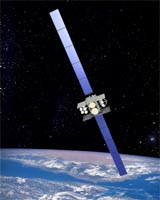
St. Louis MO (SPX) Jul 28, 2006 Boeing announced Thursday its Wideband Gapfiller Satellite program has successfully completed two more key space-to-ground compatibility tests with partners Universal Space Network and ITT Industries. The joint tests, conducted at the Boeing Satellite Development Center in El Segundo, Calif., proved the interoperability between the satellite and two key ground control systems used during orbital operations. Boeing said in a news release that it and and USN demonstrated the compatibility between the satellite's telemetry, command and ranging systems and USN's ground network. Testers controlled a WGS satellite via USN's ground network simulator at Boeing's mission control center in El Segundo. USN's network of ground stations in Hawaii, Alaska and a collaborative station in Italy will play crucial roles during WGS transfer orbit operations and initial on-orbit testing. "The successful completion of these two tests retires a significant amount of risk for the WGS program and further validates the compatibility of its satellite and ground equipment," said Claire Leon, Boeing WGS program director. "This keeps the WGS launch on track for 2007." Boeing also verified telemetry and command interface compatibility between the satellite and the Gapfiller Satellite Configuration and Control Element. The GSCCE payload control system, designed by Boeing and ITT Industries, will be fielded at Wideband Satellite Communications Operations Centers around the world. The tests confirmed the system's ability to properly configure the digital channelizer and the X-band phased array antennas, which are key elements of the WGS communications payload. WGS is the key element of a high-capacity satellite communications system, designed to quickly disseminate large amounts of data to the warfighter. With a growing need for bandwidth, including two-way, point-to-point, multicast and broadcast communications, the WGS satellites will provide additional network-centric communications capabilities for troops in the field. Boeing is under contract to build three satellites for the WGS program. The U.S. Air Force also has authorized Boeing to begin non-recurring engineering and advanced procurement of parts for a fourth WGS satellite. The WGS system is a multi-spacecraft constellation designed to provide improved communications support for the U.S. military. Community Email This Article Comment On This Article Related Links Boeing Read the latest in Military Space Communications Technology at SpaceWar.com Read the latest in Military Space Communications Technology at SpaceWar.com
 Russia Launches Kosmos Military Satellite
 Moscow, Russia (AFP) Jul 24, 2006
Russia launched a military satellite Friday from the Plesetsk Cosmodrome in the northwestern region of Arkhangelsk, the Interfax and ITAR-TASS news agencies reported. |
|
|

| The content herein, unless otherwise known to be public domain, are Copyright 1995-2006 - SpaceDaily.AFP and UPI Wire Stories are copyright Agence France-Presse and United Press International. ESA PortalReports are copyright European Space Agency. All NASA sourced material is public domain. Additionalcopyrights may apply in whole or part to other bona fide parties. Advertising does not imply endorsement,agreement or approval of any opinions, statements or information provided by SpaceDaily on any Web page published or hosted by SpaceDaily. Privacy Statement |