|
 |
 |
 |
 |
 |
 |
 |
 |

 |
Boeing-built Components Advance International Space Station Assembly
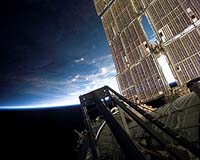
St Louis MO (SPX) Aug 15, 2006 This month's scheduled Space Shuttle Atlantis STS-115 mission resumes assembly of the International Space Station (ISS) with delivery of the Boeing Port 3/Port 4 (P3/P4) truss segment and two power-producing solar arrays. STS-115 is the first assembly mission since November 2002. "Boeing is responsible for sustainment, integration, the operations element and development of the truss systems and most of the on-board mechanical systems," said Joy Bryant, Boeing vice president and ISS program manager. "We also are responsible for the integration of the international elements." The 34,885-pound truss is the next major addition to the 11-segment integrated truss structure that eventually will span more than 300 feet and carry power, data and temperature control for the orbital outpost's electronics. The ISS, when completed in 2010, will be equivalent to a five-bedroom house, weigh almost a million pounds and measure as long as a football field including the end zones. The Atlantis crew will grab the 45-foot long by 15-foot wide truss from the payload bay with the shuttle's robotic arm and pass it to the station's robotic arm, which then will attach it to the P1 truss. P3/P4 will serve as an attachment point for P5, which will fly on a shuttle flight in December. One of the unique elements of P3/P4 is the Solar Alpha Rotary Joint, located between P3 and P4, which rotates 360 degrees every 90 minutes to keep the solar array wings oriented toward the Sun as the station orbits the Earth. "While waiting to launch the P3/P4 cargo element, we've been diligent in maintaining the flight hardware to ensure the vehicle's mechanical and electrical systems work as designed when they reach the station," said Chuck Hardison, Boeing ISS site manager at Kennedy Space Center (KSC), Fla. "The entire team is excited about resuming assembly operations." Boeing designed P3 at Huntington Beach, Calif. Boeing (now Pratt and Whitney) Rocketdyne Power and Propulsion in Canoga Park, Calif., designed P4. Assembly of P3 and P4 in Tulsa, Okla., started in 1997. Boeing delivered P3 and P4 to the Space Station Processing Facility at KSC in 1999 and 2000, respectively. The Boeing-led team joined the components at KSC shortly thereafter. Major subcontractors included Lockheed Martin, Honeywell and Hamilton Sundstrand. Because launch and installation of the solar arrays and the batteries used to store power when the station is in the Earth's shadow have been delayed so long, the ISS team replaced the lower and upper deck batteries in 2005. The new batteries will last eight to 10 years. NASA, Boeing and Lockheed Martin, who built the solar arrays, conducted extensive testing in July 2003 to ensure the arrays, which are stored in a folded, accordion-style box, properly deploy once on orbit. Community Email This Article Comment On This Article Related Links Boeing Space Station News at Space-Travel.Com
 Russia To Launch Orbital Laboratories
 Moscow (UPI) Aug 14, 2006
Russian space officials say they will launch two orbital laboratories to conduct experiments involving zero gravity, materials in space and biotechnologies. |
|
|

| The content herein, unless otherwise known to be public domain, are Copyright 1995-2006 - SpaceDaily.AFP and UPI Wire Stories are copyright Agence France-Presse and United Press International. ESA PortalReports are copyright European Space Agency. All NASA sourced material is public domain. Additionalcopyrights may apply in whole or part to other bona fide parties. Advertising does not imply endorsement,agreement or approval of any opinions, statements or information provided by SpaceDaily on any Web page published or hosted by SpaceDaily. Privacy Statement |