|
 |
 |
 |
 |
 |
 |
 |
 |

 |
Boeing Builds First GPS IIF Satellite
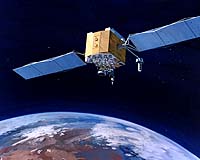
St. Louis MO (SPX) Sep 13, 2007 Boeing has successfully assembled and integrated all flight hardware onto the first Global Positioning System (GPS) IIF satellite. GPS llF will bring new capabilities to the GPS constellation such as full onboard encrypted military code, a new civil signal, crosslink enhancements, signal power increases and longer design life. "GPS IIF is on track because of the team's stellar application of back-to-basics program management," said Howard Chambers, vice president and general manager of Boeing Space and Intelligence Systems. "The performance of these subsystems is a testament to our process-based management and to our lean manufacturing commitment, and GPS IIF fully meets the specifications set forth by our U.S. Air Force customer and places us firmly on track to deliver the satellite for the first launch in 2008." Boeing is building 12 GPS Block IIF satellites under contract from the Navstar GPS Wing at the Space and Missile Systems Center in Los Angeles. The satellite's sophisticated L-band payload will include new hardware that serves the civil user community. Designed to enhance non-safety-critical applications, the signals will improve aviation and other precision safety signals. Technicians are preparing GPS IIF for key dynamic environmental tests designed to confirm its structural design and mechanical integrity. They also are attaching the solar panels and configuring the satellite before it undergoes several physical tests. The tests will help ensure robust mission assurance with an emphasis on product integrity and mission success. Each GPS IIF satellite will complete acoustic stress tests using high-powered speakers to verify that the spacecraft can tolerate the high sound pressure levels during launches; mechanical tests similar to a separation test to make sure it disconnects cleanly and correctly from the launch vehicle; tests of its deployable mechanisms such as the solar wings and the antenna to ensure that they release correctly on-orbit; and finally, GPS IIF will undergo thermal vacuum testing to confirm its ability to operate in a vacuum and under the extreme temperatures of space. Working closely with the U.S. Air Force to deliver new, advanced GPS capabilities to the military, civil government and the general public, Boeing will continue the GPS Wing's track record of on-orbit performance and constellation sustainment to guarantee GPS availability to users worldwide. Community Email This Article Comment On This Article Related Links GPS Applications, Technology and Suppliers
 India To Build Constellation Of Seven Navigation Satellites
 Bangalore, India (PTI) Sep 05, 2007
India plans to build a constellation of seven geo-stationary satellites at a cost of Rs 1,600 crore to meet the navigational system requirements in cars, trains and aircraft. "Design (of the satellites) is more or less complete. We are in the process of building the first proto model," Secretary in the Department of Space G Madhavan Nair said. |
|
|

| The content herein, unless otherwise known to be public domain, are Copyright 1995-2007 - SpaceDaily.AFP and UPI Wire Stories are copyright Agence France-Presse and United Press International. ESA Portal Reports are copyright European Space Agency. All NASA sourced material is public domain. Additional copyrights may apply in whole or part to other bona fide parties. Advertising does not imply endorsement,agreement or approval of any opinions, statements or information provided by SpaceDaily on any Web page published or hosted by SpaceDaily. Privacy Statement |