|
 |
 |
 |
 |
 |
 |
 |
 |

 |
Blue Skies On Saturn
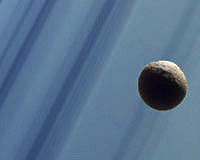
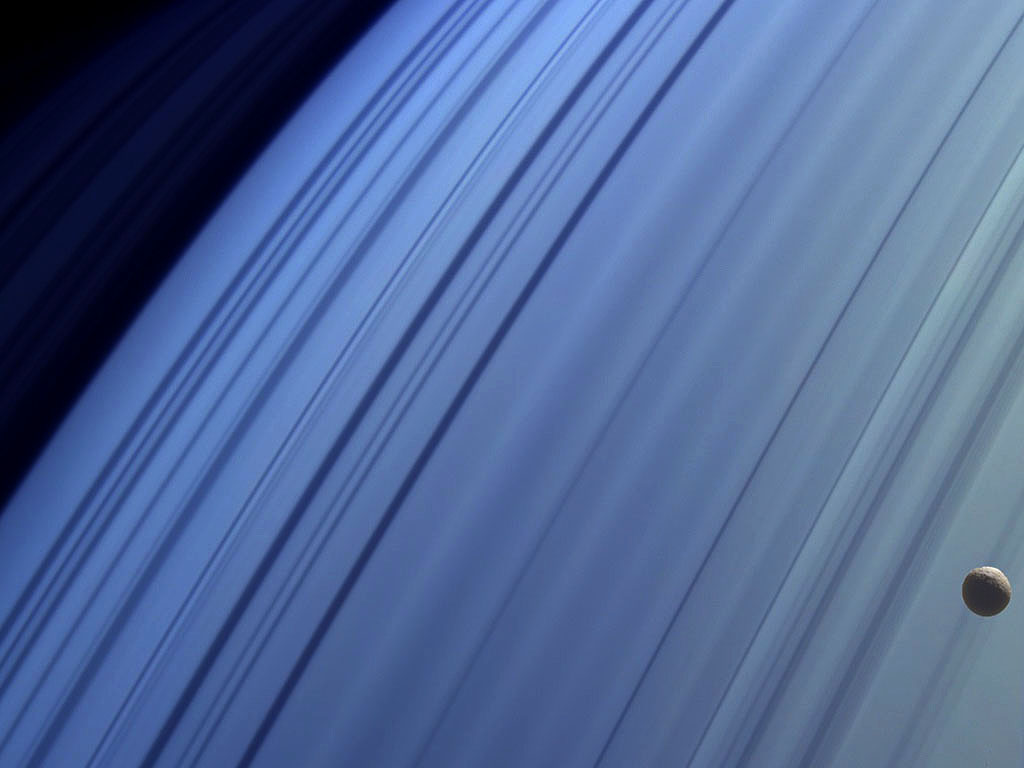
Huntsville AL (SPX) Feb 23, 2005 Fast forward 100 years: You're an astronaut piloting an airplane in the upper atmosphere of Saturn. The gas giant has no solid surface to walk on and no seas to put a boat in. Exploring Saturn means flying, dipping in and out of strangely-colored clouds, racing through ring shadows. It's a totally alien world. It's so alien that you start to feel homesick. So you do what they taught you in astronaut training. Take a deep breath, look up at the sunny blue sky and pretend to be back on Earth. Works every time! Sunny blue skies ... on Saturn? It's true. NASA's Cassini spacecraft discovered them in 2005. "We were surprised," recalls JPL's Bob West, a member of the Cassini imaging team. "Saturn is supposed to be yellow." If you've ever looked at Saturn through a backyard telescope, you know it's true: Yellow is the dominant color of Saturn's thick clouds. "Sunlight reflected from those clouds is what gives Saturn its golden hue," explains West. But Cassini saw something different. Close to Saturn, the spacecraft was able to photograph the clear air above the planet's clouds. ("Air" on Saturn is mostly hydrogen.) The color there is blue. "Saturn's skies are blue, we think, for the same reason Earth's skies are blue," says West. Molecules in the atmosphere scatter sunlight. On Earth the molecules are oxygen (O2) and nitrogen (N2). On Saturn the molecules are hydrogen (H2). Different planets, different molecules, but the effect is the same: blue light gets scattered around the sky. Other colors are scattered, too, but not as much as blue. Physicists call this "Rayleigh scattering." End of story? Not quite. "There are some things we don't understand," says West. For example, while Saturn's northern hemisphere has blue skies, Saturn's southern hemisphere does not. The south looks yellow. It could be that southern skies on Saturn are simply cloudier, yellow clouds making yellow skies. The mystery, says West, isn't why the south is cloudy - that's normal. It's why the north is clear. "For some [unknown] reason, Saturn's northern clouds have sunk deeper into the planet, leaving clear blue air behind." Saturn's north is so blue that West believes amateur astronomers could see the hue from Earth. Unfortunately, the north of Saturn is hidden at the moment behind Saturn's rings, a situation that will persist for another year or so. For now, Cassini is in the best position to investigate. Will Saturn's blue skies fade? Or grow to envelop the whole planet? No one knows. It is an alien world, after all. Community Email This Article Comment On This Article Related Links SpaceDaily Search SpaceDaily Subscribe To SpaceDaily Express Explore The Ring World of Saturn and her moons Jupiter and its Moons The million outer planets of a star called Sol News Flash at Mercury
 Cassini Images Halo Around Titanic Moon Off Saturn
 Pasadena CA (SPX) Dec 27, 2005
With its thick, distended atmosphere, Titan's orange globe shines softly, encircled by a thin halo of purple light-scattering haze. |
|
|

| The content herein, unless otherwise known to be public domain, are Copyright 1995-2006 - SpaceDaily.AFP and UPI Wire Stories are copyright Agence France-Presse and United Press International. ESA PortalReports are copyright European Space Agency. All NASA sourced material is public domain. Additionalcopyrights may apply in whole or part to other bona fide parties. Advertising does not imply endorsement,agreement or approval of any opinions, statements or information provided by SpaceDaily on any Web page published or hosted by SpaceDaily. Privacy Statement |