|
 |
 |
 |
 |
 |
 |
 |
 |

 |
Blue Planet: What Bird Brains Can Tell Us
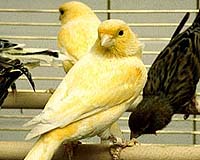
Boulder (UPI) May 19, 2005 Humans have long assumed one of the things that separates us from the lower animals is the quality of our minds. Our view of the capacity of animal minds has been heavily influenced for the past 400 years by Rene Descartes, who argued in part that since animals lack linguistic capability, they lack a mental life. Descartes thought that animals were simply automata made of meat. Even Descartes may not have been convinced completely of his own opinions, since he kept a small dog himself, breed unknown, one Monsieur Grat, of whom he was very fond. But modern scientific studies show the distance between animal minds and human ones is not nearly so great as once believed. Studies of learning and language in other animals have shown a remarkable degree of intelligence and flexibility. Studies of the brains of birds, of all things, have offered insights into the evolutionary place of birds and their ability to learn complex behavior. Blue Planet reported a few weeks ago on neurobiology research that has completely revised the view of bird cognition. "Over the past 30 years, we have learned that bird brain organization is not what we thought it was," Duke University neurobiologist Erich Jarvis told UPI's Blue Planet. "People have been discovering that bird behavior is a lot more complex than once thought." Further research on bird brains over the past few weeks provides additional evidence that the long evolutionary effort from their dinosaur ancestors to modern birds has not been wasted. Timothy Gardner and colleagues reported in a paper in Science last week that canaries, like humans, seem to have an innate language sense. Gardner studied 16 canaries that were raised by their mothers - who didn't sing - for the first 30 days of their lives, then were transferred into recording chambers. In these chambers, instead of natural canary songs, the canaries heard synthetically generated music composed by Gardner. "Each note is within the spectrum of what a canary might sing," Gardner told Blue Planet, "but the order is highly abnormal for canaries." The bird learned these new songs "remarkably well," Gardner said. "It was the only song they were exposed to, and they did almost pitch perfect imitations. They spent literally thousands of hours practicing this song." When the birds grew up, the syntax of their song became more a normal canary style. "As they transition to adulthood, they begin to sing a normal canary song," Gardner told Blue Planet. "The sequences of the sounds they heard as juveniles become rearranged to the regular syntactical structure. Some abandoned it, some could imitate both." This sequence of language learning is very similar to one observed in human beings. "People have noticed a number of correlations," Gardner said, "like the existence of a sensitive period for learning. We are primed to imitate language at an early age. What we're looking at in these juvenile birds is this period of freedom prior to puberty." Gardner added when the bird matured the "imitated songs were reprogrammed to form typical canary phrasing. Thus imitation and innate song constraints are separate processes that can be segregated in time: freedom in youth, rules in adulthood. "I think people have often made the mistake of associating innate behaviors with a lack of intelligence. That's often been an argument for regarding humans as very different," he said. However, based on the work of linguist Noam Chomsky, scientists now believe human language ability also is in large part innate - flexible until puberty when the ability to absorb languages is great, then much more restricted by rules learned in adulthood. A paper in the June PLOS Biology shows how the neural organization of pigeons is parallel to that assumed for humans. "In 1861, Paul Broca proclaimed that the 'majesty of the human' could be attributed to its superior faculties, such as abstraction and judgment, and that these superior faculties lie within the province of the 'anterior lobes of the brain,'" write Jonas Rose and Michael Colombo of New Zealand's University of Otago. "Executive control" of the brain - the ability to plan one's behavior to achieve a goal - lies in the frontal lobe of humans and other primates. Rose and Colombo also have found this executive control is present in the humble pigeon, fundamental to memory and cognition. "It would appear that the ability to filter relevant and irrelevant information, which some have argued is a fundamental form of executive control, is clearly not an exclusive feature of the mammalian brain," the authors wrote. "There is little doubt that it is commonplace to richly interpret human behavior. But when you show that pigeon can recognize itself in a mirror, or that a crow can manufacture a tool, it is not just an interesting demonstration, but it also refines our views regarding the neural mechanism that underlie such behavior."
Community
 Magnetic Reconnection Region Larger Than 2.5 Million Km Found In The Solar Wind
 Paris (ESA) Jan 12, 2006
Using the ESA Cluster spacecraft and the NASA Wind and ACE satellites, a team of American and European scientists have discovered the largest jets of particles created between the Earth and the Sun by magnetic reconnection. This result makes the cover of this week's issue of Nature. |
|
|

| The content herein, unless otherwise known to be public domain, are Copyright 1995-2006 - SpaceDaily.AFP and UPI Wire Stories are copyright Agence France-Presse and United Press International. ESA PortalReports are copyright European Space Agency. All NASA sourced material is public domain. Additionalcopyrights may apply in whole or part to other bona fide parties. Advertising does not imply endorsement,agreement or approval of any opinions, statements or information provided by SpaceDaily on any Web page published or hosted by SpaceDaily. Privacy Statement |