|
 |
 |
 |
 |
 |
 |
 |
 |

 |
Blood, oil and ancient glories: a factfile on Iraq
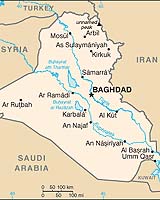
Baghdad (AFP) May 20, 2006 Iraq, which on Saturday formed a national unity government in the midst of widespread bloodshed, sits on some of the world's largest oil reserves. Under its former name of Mesopotamia, the country had a more positive claim to fame, as the "fertile crescent" between its Tigris and Euphrates rivers gave birth to one of the world's first civilisations. Basic facts about Iraq: - GEOGRAPHY: Iraq borders Iran, Jordan, Kuwait, Saudi Arabia, Syria and Turkey. It has a narrow outlet to the sea on the Gulf and a surface area of 438,317 square kilometres (169,235 square miles) -- slightly bigger than the US state of California, but smaller than France. The capital is Baghdad. - POPULATION: 26 million, of whom around 76 percent are Arabs and 20 percent Kurds. Other minorities include Turkmen. - HISTORY: Mesopotamian culture flowered between the fifth and the second millennium before Christ. The rise of Islamic culture from the 7th century BC was braked by Mongol invasions in the 13th century. Iraq later spent almost four centuries under Ottoman rule, until the British took over in 1918. The country became independent in 1932, although the British and later the United States retained major influence. Oil became a coveted military asset during World War II, and the postwar period saw several military coups, the last one of which, in 1963, led to Saddam Hussein and his Baath Party taking power. Under Saddam, Iraq was involved in a disastrous war with its neighbour Iran between 1980 and 1988. Although the Western powers claimed to be neutral, the United States clearly favoured the Saddam regime against Iran, which had ousted the US-backed regime of the Shah and set up an Islamic Republic. In 1990, in the aftermath of the war, Saddam invaded neighbouring Kuwait, which led to a US-led operation to expel the Iraqi forces in February 1991. In 1991, the UN Security Council imposed the widest-ranging set of sanctions in its history against Iraq, which was accused of seeking weapons of mass destruction. After the attacks of September 2001 on the United States, Washington laid plans to invade Iraq again, which it did in March 2003, with backing from Britain and other allies but without UN approval. The weapons that had been cited as the justification for the invasion were never found. Iraq today is formally independent, but home to over 145,000 foreign troops, of whom 132,000 are Americans. A constitution adopted in October 2005 gave wide powers to the regions, strengthening what has become a de facto Kurdish state in the north. The parliament that emerged from elections in January this year is dominated by Shiite parties. - ECONOMY AND RESOURCES: Iraq is believed to have 11 percent of the world's total remaining oil reserves, making it potentially one of the world's biggest producers. Since the invasion, however, production has been hit by sabotage and the long-term effects of sanctions, and remains below the pre-2003 levels. Iraq is a member of the Organisation of Petroleum Exporting Countries. Agriculture, the other mainstay of the pre-war economy, has also been hard hit by the violence, as has the production of basic necessities such as electricity and water. In 2005 foreign debt was estimated at some 120 billion dollars. MILITARY: US-led forces are struggling to set up and train a new Iraqi army, after disbanding the old one in 2003. Figures on how many Iraqi units are actually operational are disputed, however. - RELIGION: The overwhelming majority of Iraq's population is Muslim, although there is a small Chaldean Christian community. The conflicts sparked by military occupation have exacerbated differences between Shiite and Sunni Muslims. Shiites are estimated to make up around 60 percent of the population, while Arab Sunnis, who were dominant under Saddam, account for between 20 and 25 percent. The occupation has also led to a steep rise in Islamic extremism, which was kept in check during the secular regime of Saddam Hussein. HUMAN RIGHTS: Both the pre- and post occupation periods have seen massive human rights abuses. Since the invasion there have been widely publicised cases of torture committed by US and British forces, and also by Iraqi troops and police. Insurgent groups have also committed numerous massacres, and much of the country is lawless. WAR CASUALTIES: Estimates of total Iraqi casualties in three years of war range from around 34,000 to well over 100,000. US authorities have refused to keep a tally. The United States has lost more than 2,400 military personnel, and Britain more than 110. Community Email This Article Comment On This Article Related Links Nuclear Space Technology at Space-Travel.com
 Missile Defense Boost Vehicle To Get Orbus 1a Motors
 Courtland AL (SPX) Apr 28, 2006
Lockheed Martin's Alabama production facility has received the first two Orbus 1A motor assemblies from Alliant Techsystems for the Boost Vehicle-Plus program. |
|
|

| The content herein, unless otherwise known to be public domain, are Copyright 1995-2006 - SpaceDaily.AFP and UPI Wire Stories are copyright Agence France-Presse and United Press International. ESA PortalReports are copyright European Space Agency. All NASA sourced material is public domain. Additionalcopyrights may apply in whole or part to other bona fide parties. Advertising does not imply endorsement,agreement or approval of any opinions, statements or information provided by SpaceDaily on any Web page published or hosted by SpaceDaily. Privacy Statement |