
 |
 |
 |
 |
 |
 |
 |
 |
 |

 |
Birds can't keep up with climate change: study
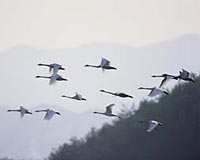
Paris (AFP) Aug 20, 2008 The habitats of wild bird species are shifting in response to global warming, but not fast enough to keep pace with rising temperatures, according to a study released Wednesday. Researchers in France also found that the delicate balance of wildlife in different ecosystems is changing up to eight times more quickly than previously suspected, with potentially severe consequences for some species. "The flora and fauna around us are shifting over time due to climate change," said lead author Victor Devictor, a researcher at the French National Museum of Natural History. "The result is desynchronisation. If birds and the insects upon which they depend do not react in the same way, we are headed for an upheaval in the interaction between species," he explained in a telephone interview. These "mismatches" are likely to become greater over time, and could eventually threaten some birds with extinction, he added. The study showed that the geographic range of 105 birds species in France -- accounting for 99.5 percent of the country's wild avian population -- moved north, on average, 91 kilometres (56.5 miles) from 1989 through 2006. Average temperatures, however, shifted northward 273 kilometres (170 miles) over the same period, nearly three times farther. The fact that some birds have responded to climate change had already been noted in individual species. What surprised Devictor and his colleagues was that the shift held true for virtually all birds in France, and that the gap with the rising temperatures was big and getting bigger. "The response is faster than we thought, but it is still not fast enough to keep up with climate change," he said. Earlier studies looked at the impact of global warming by comparing "snapshots" -- taken years or decades apart -- of the range across which a given species lived. But trying to define the outer boundary of a shifting habitat is extremely difficult because data is, by definition, scarce. Devictor took another approach, taking advantage of France's French Breeding Bird Survey, which has gathered data collected by hundreds of ornithologists from more than 1500 well-defined plots since 1989. This made it possible to look at the entire distribution of a species over a continuous period, he explained. The northward shift of most species "is most likely changing at its maximal possible rate, which is insufficient to catch up to climate change," Devictor said. "This discrepancy may have profound consequences on the ability of species to cope with climate change in the long run." The study was published in the British journal Proceedings of The Royal Society B: Biological Sciences. Community Email This Article Comment On This Article Share This Article With Planet Earth
Related Links Darwin Today At TerraDaily.com
 Trees, Forests And The Eiffel Tower Reveal Theory Of Design In Nature
 Durham NC (SPX) Aug 19, 2008
What do a tree and the Eiffel Tower have in common? According to a Duke University engineer, both are optimized for flow. In the case of trees, the flow is of water from the ground throughout the trunk, branches and leaves, and into the air. |
|
|

| The content herein, unless otherwise known to be public domain, are Copyright 1995-2007 - SpaceDaily.AFP and UPI Wire Stories are copyright Agence France-Presse and United Press International. ESA Portal Reports are copyright European Space Agency. All NASA sourced material is public domain. Additional copyrights may apply in whole or part to other bona fide parties. Advertising does not imply endorsement,agreement or approval of any opinions, statements or information provided by SpaceDaily on any Web page published or hosted by SpaceDaily. Privacy Statement |
 del.icio.us
 Digg
Digg Reddit
 YahooMyWeb
 Google
 Facebook