|
 |
 |
 |
 |
 |
 |
 |
 |

 |
Biosphere Under the Glass
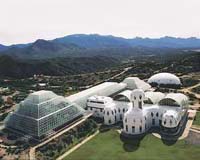
Moffett Field - Mar 01, 2004 The $150 million Biosphere 2 first opened in 1991 as a massive closed system that would last for 100 years of testing nature, technology and human endurance. It is the world's largest experimental site and was given the mission name, Biosphere 2, in deference to the much larger Biosphere 1: the Earth itself. Two early human survival missions lasted for two years and six months respectively. Organizers have announced this month that visitors can enter the giant glass-covered pyramid for the first time. The Biosphere 2 complex occupies 3.15 acres in Oracle, Arizona-- 20 minutes north of Tucson. Since opening in the early 90's nearly two million visitors have toured the sprawling site and the Bio2 complex. "In the past we had to limit the number of people that went inside which made it a premium tour," said Rick Neter, Director of Business Operations. "We are now able to offer the under-the-glass tour to everyone." What awaits are mini-worlds, or biome habitats. The glass ceiling is so high, that one can create rain that is like real rain. The biomes feature a cliff above the one million gallon saltwater ocean, a walk through the upper and lower savannahs, thorn scrub, desert and technosphere, finally investigations inside the south lung complex. Visitors then continue to the underwater ocean viewing gallery exhibit before returning to the starting point on the hill overlooking Biosphere 2. "[As] the only one of its kind in the world, we provide a unique experience that you just cannot get anywhere else," said Gilbert LaRoque, one of Biosphere's Manager. "People come from all over the world." What are Biospherians? The early Biosphere inhabitants kept extensive psychological and medical logs, thus studying themselves as well as their environment while daily farming, cooking or hunting did not otherwise occupy their days. These first subjects became known as 'biospherians'. From its outset, the Biosphere 2 project sought to model the influence of life on the environment and vice versa. As planetary scientist, Dr. David Grinspoon, pointed out about our own planet: "Earth wouldn't have 'Earth-like' conditions without life, because life has shaped the world we know. For instance, photosynthetic organisms created the oxygenated atmosphere, as well as the ozone layer that protects us from the Sun's most destructive rays. "So to say another planet must be Earth-like in order to support life is to put the cart before the horse. Instead, a planet must support life in order to be Earth-like...I suspect that life can only survive on a planet for billions of years if it has become deeply embedded in the geochemical, physical, and climatic cycles of that planet in a way that stabilizes the environment." Among the aquatic types of biomes at Oracle, one finds an artificial ocean, coral reefs, lagoons, and beaches. Angelfish, parrot fish, and sergeant majors are among the 300 fish that inhabit this self-sustaining environment, alongside crustaceans, sea-urchins, sponges, and algae. Among the land forms in the greenhouse are an equatorial rainforesst, desert, savannah, marsh and a three-chambered, managed forest. One challenge for the multi-user experiments has been that each biome can only sustain one set of environmental conditions at a time, and always has the ability to leak its influence just like the natural biosphere introduces complex feedbacks that may compensate for a given change in carbon dioxide, temperature, humidity or species. To simplify maintanence, the rainforest today lacks a typical Amazonian biodiversity, since that biome sustains only small creature like ants, cockroaches, spiders, and snails. Living in a Fishbowl First sealed as a simulator of future closed space habitats, the longest period that the project tried to sustain its diverse ecosystems with eight human biospherians spanned September 26, 1991-1993. During this first mission, oxygen levels fell to threatening levels for human respiration, along with an accompanying fall in carbon dioxide which limited plant productivity. One cause of this anomaly was later diagnosed as adsorption of the gases into various parts of the concrete foundation (forming calcium carbonates for example). When the biosphere's seal was broken to supplement oxygen and other supplies, the habitability tests in closed ecosystems became less of a priority. A second six month stint was undertaken in 1994. Since 1995, the Biosphere 2 management has been handled by Columbia University, with over 1200 graduate students spending a year in the center. The Columbia 'western campus' was partly undertaken to transform the research focus from human survival in space to global warming issue related to the effects of carbon dioxide. On December 22, 2003, Columbia turned over the complex to a holding group, which has announced their recent public visitation plan. Two other projects, including a Japanese Biosphere J and Biosphere 3, have been proposed to supplement the history of closed ecosystem research, along with the BIOS series The term 'biosphere' dates to 1875, when geologist Eduard Suess began to acknowledge how Charles Darwin's ideas about natural selection were influencing earth science. Along with the term, 'ecosystem', the concept of how cycles are regulated between land, water and air has taken hold in diverse fields ranging from astronomy to meteorology. "We don't know how hard it is for a planet to evolve a biosphere, or to become a 'living world,' but once it gets to that state," Grinspoon told Astrobiology Magazine, "I would bet that such biospheres survive for billions of years." The 'Gaia hypothesis' as popularized by the English atmospheric scientist, James Lovelock, introduced feedback from biology into traditional geochemistry, with a view towards how the Earth might behave as a self-regulating living system or single organism. Although debated among the various disciplines, this cross-disciplinary approach to defining key parts of a biosphere has introduced new ways of considering how environmental change is regulated and co-evolves in a variant on biological homeostasis. In addition to Lovelock's, scientific approaches to this problem have been formulated by Lynn Margulis, Richard Dawkins and Carl Sagan, among others. In the spirit of viewing the earth's complex biosphere as a single unit, the World Wildlife Fund has recently identified 200 ecoregions as the most critical for conservation. Their initiative was partly in response to how much rainforests as home to fifty percent of the planet's species had come to dominate other threatened or shrinking ecosystems such as coral reefs. The Global 200 actually lists 233 ecoregions, which include 136 terrestrial, 36 freshwater, and 61 marine ecoregions. Terraform a Planetary Terrarium? One of the key questions about Mars in the context of a biosphere, is 'Is there enough nitrogen on the planet'" to support life? John Rummel, NASA's Planetary Protection Officer, is one who has doubts about the advisability of implementing remodelling projects on other planets. Rummel believes that to try "to grow plants on Mars would take power and other resources" that could be put to better use. "We would need to do a lot of analysis of Mars surface material before sending a biological experiment there." Rummel doesn't disagree that growing a plant on Mars could serve as a powerful symbol. He wonders, though, what the symbolic impact would be if the experiment failed. "If we want to think of Mars as a place where Earth organisms can grow, we want to know it will work." "There are many logical reasons not to send a plant to Mars on a near-term mission," concede Dr. Chris McKay, one of the organizers of a NASA terraforming conference. But, he counters, "it is a bold and dramatic step that will, in my humble opinion, push the biological agenda for Mars ahead significantly." Article is courtesy of NASA's Astrobiology Magazine team at Ames Research Center. This article is public domain and available for reprint with appropriate credit. CommunityEmail This Article Comment On This Article Related Links SpaceDaily Search SpaceDaily Subscribe To SpaceDaily Express Dirt, rocks and all the stuff we stand on firmly
 Magnetic Reconnection Region Larger Than 2.5 Million Km Found In The Solar Wind
 Paris (ESA) Jan 12, 2006
Using the ESA Cluster spacecraft and the NASA Wind and ACE satellites, a team of American and European scientists have discovered the largest jets of particles created between the Earth and the Sun by magnetic reconnection. This result makes the cover of this week's issue of Nature. |
|
|

| The content herein, unless otherwise known to be public domain, are Copyright 1995-2006 - SpaceDaily.AFP and UPI Wire Stories are copyright Agence France-Presse and United Press International. ESA PortalReports are copyright European Space Agency. All NASA sourced material is public domain. Additionalcopyrights may apply in whole or part to other bona fide parties. Advertising does not imply endorsement,agreement or approval of any opinions, statements or information provided by SpaceDaily on any Web page published or hosted by SpaceDaily. Privacy Statement |