|
 |
 |
 |
 |
 |
 |
 |
 |

 |
Bionic Eye Offers New Window On The World
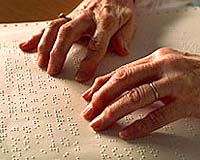
Lausanne - Dec 01, 2003 The microchip could prevent progressive blindness Retinal diseases afflict millions of people worldwide, and in the worst cases can lead to blindness. But Swiss researchers are hopeful that a microchip, implanted in the eye, could restore sufferers' sight by acting as an artificial retina. "The prospects for such a project have become better as our physiological knowledge and the technical possibilities have converged," said Philippe Renaud from the Federal Institute of Technology in Lausanne. Renaud's laboratory is collaborating with Geneva University Hospital on the project. A healthy human eye has millions of cells, which convert light into electrical signals. These are then sent along the optic nerve to the brain to be interpreted. Many people who gradually go blind are suffering from the malfunction or destruction of these photoreceptors or light-sensing cells. Although these cells at the back of the eye have degenerated, the link back to the brain is often still intact. The chip would be placed at the back of the eye (swissinfo)
Artificial sensor The microchips have to be small enough to be implanted in the eye and compatible with the surrounding eye tissue. The Swiss chip, which is about 1.5 millimetres square, consists of a 14 by 14 array of light sensitive cells. Its thickness is a mere one- 50th of a millimetre. As researchers are able to put more cells onto each chip, the resolution of images should improve further. Experiments have shown that 100 pixels � the dots of illumination that make up an image � are sufficient to read single letters on a computer screen. It is generally believed that at least 500 pixels are needed to restore useful vision. The chip, developed in Switzerland, consists of many layers with different materials including silicon and aluminium. "Both materials are not stable in the body so we packed up the chip in biocompatible plastic and coated the electrodes with platinum," said Dominik Ziegler, who worked on the project for his diploma at the Federal Institute of Technology in Lausanne.
Human trials The people most likely to benefit are those suffering from retinitis pigmentosa, a rare inherited disease that causes blindness by destroying the retina, and age-related macular degeneration, a condition which causes a deterioration of the central part of the retina in the elderly. In the United States, sightless patients have already been able to see light and in some cases pick out shapes and recognise faces after having an artificial retina inserted in their eyes. Community Email This Article Comment On This Article Related Links SpaceDaily Search SpaceDaily Subscribe To SpaceDaily Express All about the robots on Earth and beyond!
 Engineers Deliver Robot to Neutralize Remote Explosives
 Tyndall AFB (SPX) Jun 30, 2005
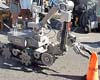
Engineers from the Air Force Research Laboratory Materials and Manufacturing Directorate have rapidly prototyped, developed, and delivered low-cost expendable robots to disable and dispose of improvised explosive devices. |
|
|

| The content herein, unless otherwise known to be public domain, are Copyright 1995-2006 - SpaceDaily.AFP and UPI Wire Stories are copyright Agence France-Presse and United Press International. ESA PortalReports are copyright European Space Agency. All NASA sourced material is public domain. Additionalcopyrights may apply in whole or part to other bona fide parties. Advertising does not imply endorsement,agreement or approval of any opinions, statements or information provided by SpaceDaily on any Web page published or hosted by SpaceDaily. Privacy Statement |