|
 |
 |
 |
 |
 |
 |
 |
 |

 |
Biologically Inspired Sensors Can Augment Sonar, Vision System In Submarines
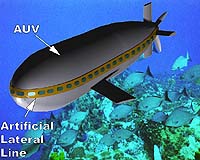
Champaign IL (SPX) Feb 23, 2007 To find prey and avoid being preyed upon, fish rely on a row of specialized sensory organs along the sides of their bodies, called the lateral line. Now, a research team led by Chang Liu at the University of Illinois at Urbana-Champaign has built an artificial lateral line that can provide the same functions in underwater vehicles. "Our development of an artificial lateral line is aimed at enhancing human ability to detect, navigate and survive in the underwater environment," said Liu, a Willett Scholar and a professor of electrical and computer engineering at Illinois. "Our goal is to develop an artificial device that mimics the functions and capabilities of the biological system." In fish, the lateral line provides guidance for synchronized swimming, predator and obstacle avoidance, and prey detection and tracking. Equipped with an artificial lateral line, a submarine or underwater robot could similarly detect and track moving underwater targets, and avoid collisions with moving or stationary objects. The artificial lateral line consists of an integrated linear array of micro fabricated flow sensors, with the sizes of individual sensors and spacings between them matching those of their biological counterpart. "By detecting changes in water pressure and movement, the device can supplement sonar and vision systems in submarines and underwater robots," said Liu, who also is affiliated with the university's Beckman Institute for Advanced Science and Technology, the Institute for Genomic Biology, and the Micro and Nanotechnology Laboratory. Liu and colleagues at Illinois and at Bowling Green State University described their work in the Dec. 12, 2006, issue of the Proceedings of the National Academy of Sciences. To fabricate the tiny, three-dimensional structures, individual components are first cast in place on sacrificial layers using photolithography and planar deposition. A small amount of magnetic material is electroplated onto each of the parts, which are then freed from the substrate by an etchant. When a magnetic field is applied, the induced torque causes the pieces to rotate out of the plane on tiny hinges and lock into place. Each sensor is integrated with metal-oxide-superconductor circuitry for on-chip signal processing, noise reduction and data acquisition. The largest array the researchers have built consists of 16 flow sensors with 1 millimeter spacing. Each sensor is 400 microns wide and 600 microns tall. In tests, the researchers' artificial lateral line was able to localize a nearby underwater vibrating source, and could detect the hydrodynamic wake (such as the wake formed behind a propeller-driven submarine) for long-distance tracking. With further advances in engineering, man-made underwater vehicles should be able to autonomously image hydrodynamic events from their surroundings, Liu said. "Although biology remains far superior to human engineering, having a man-made parallel of the biological system allows us to learn much about both basic science and engineering," Liu said. "To actively learn from biology at the molecular, cellular, tissue and organism level is still the bigger picture." Community Email This Article Comment On This Article Related Links University of Illinois at Urbana-Champaign Naval Warfare in the 21st Century Naval Warfare in the 21st Century
 Raytheon Delivers Software Build For DDG 1000
 Tewksbury MA (SPX) Feb 21, 2007
Raytheon has delivered the software build for the Total Ship Computing Environment Infrastructure Release 4.0, the new open architecture baseline software application for the DDG 1000 Zumwalt class destroyer. Among its major capabilities, TSCEI 4.0 supports IBM(R) blade server processors running the Red Hat Linux(R) operating system. It is the first of four planned increments supporting DDG 1000 Release 4 software. |
|
|

| The content herein, unless otherwise known to be public domain, are Copyright 1995-2006 - SpaceDaily.AFP and UPI Wire Stories are copyright Agence France-Presse and United Press International. ESA PortalReports are copyright European Space Agency. All NASA sourced material is public domain. Additionalcopyrights may apply in whole or part to other bona fide parties. Advertising does not imply endorsement,agreement or approval of any opinions, statements or information provided by SpaceDaily on any Web page published or hosted by SpaceDaily. Privacy Statement |