
 |
 |
 |
 |
 |
 |
 |
 |
 |

 |

Millbrook NY (SPX) Feb 14, 2011 If society wants to address big picture environmental problems, like global climate change, acid rain, and coastal dead zones, we need to pay closer attention to the Earth's coupled biogeochemical cycles. So reports a special issue of Frontiers in Ecology and the Environment, published this month by the Ecological Society of America. "There are nearly seven billion people on the planet. And our activities are throwing the Earth's biogeochemical cycles out of sync, to the detriment of air and water resources, climate stability, and human health," comments Dr. Jonathan J. Cole, a limnologist at the Cary Institute of Ecosystem Studies and co-editor of the special issue. A biogeochemical cycle is a pathway by which a chemical element, such as carbon, moves through Earth's biosphere, atmosphere, hydrosphere, and lithosphere. Some thirty cycles govern the composition of our environment, among them carbon, nitrogen, oxygen, and phosphorus. Historically, biogeochemical cycles have been studied individually. But in the natural world, element cycles are intimately tied to one another, and seemingly small perturbations can have large impacts across cycles. The Frontiers issue puts forth a new framework for understanding the biological, geological, and chemical processes that shape element cycles, and the ways in which they are coupled to one another. It represents one of the first efforts to convene atmospheric scientists and ecologists on the topic. In addition to Cole, it was edited by Drs. Adrien C. Finzi of Boston University and Elisabeth A. Holland of the National Center for Atmospheric Research. Dr. William H. Schlesinger, president of the Cary Institute and a contributor, notes, "The coupled biogeochemical cycle framework not only explains the causes of many of today's leading environmental problems, it provides a road map for finding solutions at the global scale." Consider the connection between farms and fish. In the U.S., two-thirds of our estuaries are degraded by nitrogen and phosphorus pollution, which is often a by-product of agriculture. Livestock waste and crop fertilizer make their way into coastal waterways, where they stimulate algal blooms that strip oxygen from deep waters, degrade sensitive habitat, and ultimately kill fish. A better understanding of how nitrogen, phosphorus, and oxygen cycles interact could help balance agricultural needs with the health and productivity of estuaries. Coupled-cycles can also strengthen our ability to predict and manage climate change. Forests play a role in removing carbon dioxide from the atmosphere. A forest's ability to sequester atmospheric carbon-an attribute that helps minimize climate change-is tied to nitrogen, phosphorus, and water availability. Yet current global climate models don't incorporate these couplings in realistic ways. An integrated view could provide a more accurate view of forest carbon sequestration limits, while helping to guide sustainable forestry practices. Dr. Finzi concludes, "We are at a turning point. From satellite imagery to real-time environmental monitoring, we have the technology needed to reveal how coupled biogeochemical cycles shape the world and how our actions disrupt them. Now we need to focus on integrating data across observational and experimental networks and applying insights to management decisions." The Frontiers issue was supported by the National Science Foundation, and is available online
Share This Article With Planet Earth
Related Links Cary Institute of Ecosystem Studies Earth Observation News - Suppiliers, Technology and Application

 Satellites Locate Seized Italian Oil Tanker
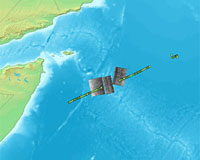
Paris, France (ESA) Feb 14, 2011 The Cosmo-SkyMed satellites, operated by the Italian space agency, have acquired the first images of the Italian oil tanker Savina Caylyn since it was hijacked earlier this week by Somali pirates in the Indian Ocean. According to the satellite radar images, acquired by Italian space agency (ASI) and e-GEOS on Wednesday afternoon and early Thursday morning, the seized ship is about 330 km o ... read more |
|
|
| The content herein, unless otherwise known to be public domain, are Copyright 1995-2010 - SpaceDaily. AFP and UPI Wire Stories are copyright Agence France-Presse and United Press International. ESA Portal Reports are copyright European Space Agency. All NASA sourced material is public domain. Additional copyrights may apply in whole or part to other bona fide parties. Advertising does not imply endorsement,agreement or approval of any opinions, statements or information provided by SpaceDaily on any Web page published or hosted by SpaceDaily. Privacy Statement |


 del.icio.us
 Digg
Digg Reddit
 YahooMyWeb
 Google
 Facebook


