|
 |
 |
 |
 |
 |
 |
 |
 |

 |
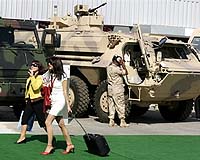
Biggest Mideast Arms Fair Opens In UAE
Abu Dhabi (AFP) Feb 18, 2007 The Middle East's biggest arms fair, IDEX-2007, opened in the United Arab Emirates Sunday with hundreds of manufacturers displaying state-of-the-art weaponry to oil-rich monarchies that are keen on upgrading their armed forces. The eighth bi-annual International Defence Exhibition, which was first held in 1993, was opened by UAE President Sheikh Khalifa bin Zayed al-Nahayan. The UAE is determined to "reinforce its defence capacity through the acquisition of the most sophisticated equipment in the military industry worldwide," Sheikh Khalifa told participants. "Our country is a country of peace ... but we think that peace needs a force to protect it." A total of 862 exhibitors from 50 countries, including the United States, France, Britain, China, Italy, Turkey, Russia and South Korea, are showcasing their latest products for deep-pocketed Gulf countries. The pro-Western Gulf Arab states are seeking to reinforce their armed forces and security systems amid heightened instability in neighbouring Iraq and the international community's nuclear standoff with Iran. The organisers of the five-day exhibition, who are expecting some 40,000 visitors, boasted that previous editions of the show had "largely influenced armament decisions by countries in the Middle East, Africa and Asia." After earning more than 400 billion dollars in oil revenues in 2006 on the back of high world prices, the six Gulf Arab states have record budget surpluses and money to spend. Between them Bahrain, Kuwait, Qatar, Oman, Saudi Arabia and the UAE control some 45 percent of world oil reserves. In 2006, they concluded armament deals worth 35 billion dollars, said Mustafa Alani, a security expert at the Dubai-based Gulf Research Centre (GRC). British suppliers won some 13 billion dollars of these contracts, US firms 11 billion and French manufacturers 10 billion, Alani told AFP. Between 2000 and 2005, accummulated armament spending by the six countries totalled 233 billion dollars, representing 70 percent of armament expenditure in the Arab world and four percent worldwide, a survey published by the GRC in January found. Last summer, the Pentagon notified Congress of possible arms sales to Saudi Arabia -- the biggest spender of the six -- totalling well over nine billion dollars. The mooted deals included M1 Abrams tanks, light armoured vehicles, Black Hawk helicopters and upgrades for AH-64 attack helicopters. Despite their huge spending on defence, the six Gulf Arab states will ultimately remain dependent for their protection on the Western countries that consume their oil, Alani said. "Whatever their military expenditure is, the GCC countries will never manage to ensure their self-defence and will always need an 'exterior defence'," he said. It took a US-led coalition to expel Saddam Hussein's troops from Kuwait in 1991 after they swept through the small emirate in just a few hours the previous year. Sophisticated military equipment will only allow the Gulf states' armed forces to "delay the advance of the enemy for the time needed to arrange for an exterior defence," Alani said.
Source: Agence France-Presse Community Email This Article Comment On This Article Related Links The Military Industrial Complex at SpaceWar.com The Military Industrial Complex at SpaceWar.com Learn about the Superpowers of the 21st Century at SpaceWar.com
 US Playing Anti-Russian Card To Raise Defense Spending
 Amman (RIA Novosti) Feb 14, 2007
President Vladimir Putin accused the United States of 'playing the anti-Russian card' to solve its domestic problems and secure more substantial defense spending. "I have an impression that some partners are promoting themselves and have started using the non-existent Russian threat to get more money from the U.S. Congress for military operations in Iraq, Afghanistan, and the expensive missile defense project," Putin said during his visit to Jordan, adding that it was not Russia's problem. |
|
|

| The content herein, unless otherwise known to be public domain, are Copyright 1995-2006 - SpaceDaily.AFP and UPI Wire Stories are copyright Agence France-Presse and United Press International. ESA PortalReports are copyright European Space Agency. All NASA sourced material is public domain. Additionalcopyrights may apply in whole or part to other bona fide parties. Advertising does not imply endorsement,agreement or approval of any opinions, statements or information provided by SpaceDaily on any Web page published or hosted by SpaceDaily. Privacy Statement |