|
 |
 |
 |
 |
 |
 |
 |
 |

 |
Bigger Isn't Always Better
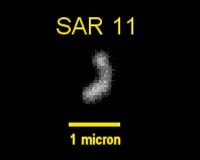
Moffett Field CA (SPX) Aug 25, 2005 Researchers at Oregon State University and Diversa Corporation have discovered that the smallest free-living cell known also has the smallest genome, or genetic structure, of any independent cell - and yet it dominates life in the oceans, thrives where most other cells would die, and plays a huge role in the cycling of carbon on Earth. In nature, apparently, bigger is not always better. Publishing in the journal Science, scientists outlined the growing knowledge about SAR11, a group of bacteria so dominant that their combined weight exceeds that of all the fish in the world's oceans. In a marine environment that's low in nutrients and other resources, they are able to survive and replicate in extraordinary numbers - a milliliter of sea water off the Oregon coast might contain 500,000 of these cells. "The ocean is a very competitive environment, and these bacteria apparently won the race," said Stephen Giovannoni, an OSU professor of microbiology. "Our analysis of the SAR11 genome indicates that they became the dominant life form in the oceans largely by being the simplest." The new study outlines how SAR11 has one of the most compact, streamlined genomes ever discovered, with only 1.3 million base pairs - the smallest ever found in a free living organism, and a number that's literally tiny compared to something like the human genome. "SAR11 has almost no wasted DNA," Giovannoni said. "This organism is extremely small and efficient. Every genetic part serves a purpose, more so than any other genome we've studied." The organism is able to survive as an unattached cell in a hostile environment, has a complete set of biosynthetic pathways, and can reproduce efficiently by consuming dissolved organic matter. "By comparison, humans are mostly junk DNA, with large parts of the human genome having no important function," Giovannoni said. This type of genome streamlining, researchers say, appears to be a major factor in the evolutionary success of SAR11, which they believe may have been thriving for a billion years or more. One scientific hypothesis holds that natural selection acts to reduce genome size because of the metabolic burden of replicating "junk" DNA with no adaptive value. SAR11 supports that theory. Researchers are particularly interested in SAR11, Giovannoni said, because of the critical role it plays in geochemistry. Photosynthesis is a process used by plants to convert sunlight energy into organic molecules, creating the foundation of the food chain and producing oxygen. About half of photosynthesis and the resulting oxygen on Earth are produced by algae in the ocean, and microbes like SAR11 recycle organic carbon - producing the nutrients needed for algal growth. "Ultimately, SAR11 through its sheer abundance plays a major role in the Earth's carbon cycle," Giovannoni said. "Quite simply, this is something we need to know more about. SAR11 is a major consumer of the organic carbon in the oceans, which nearly equals the amount of carbon dioxide in the atmosphere. The carbon cycle affects all forms of plant and animal life, not to mention the atmosphere and fossil fuel formation." SAR11 was first discovered at OSU in 1990. Since then researchers have learned that populations of SAR11 increase during the summer and decrease during the winter, in a cycle that correlates to the ebb and flow of organic carbon in the ocean surface. Molecular probes, gene cloning, sequencing techniques and other tools have been used in this exploration. Community Email This Article Comment On This Article Related Links SpaceDaily Search SpaceDaily Subscribe To SpaceDaily Express Darwin Today At TerraDaily.com
 Panda Paparrazi Swoons Over Cub Tai Shan At Washington Zoo
 Washington (AFP) Nov 29, 2005
There was 'panda-monium' at Washington's National Zoo on Tuesday as fluffy giant panda cub Tai Shan cavorted for the cameras, in his first encounter with the media pack. |
|
|

| The content herein, unless otherwise known to be public domain, are Copyright 1995-2006 - SpaceDaily.AFP and UPI Wire Stories are copyright Agence France-Presse and United Press International. ESA PortalReports are copyright European Space Agency. All NASA sourced material is public domain. Additionalcopyrights may apply in whole or part to other bona fide parties. Advertising does not imply endorsement,agreement or approval of any opinions, statements or information provided by SpaceDaily on any Web page published or hosted by SpaceDaily. Privacy Statement |