Energy News  
Big Space Junk

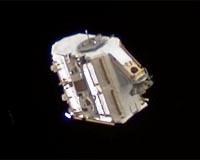
An Early Ammonia Servicer (EAS) moves away from the International Space Station after it was jettisoned by astronaut Clay Anderson (out of frame), Expedition 15 flight engineer, during a session of extravehicular activity (EVA). The EAS was installed on the P6 truss during STS-105 in August 2001, as an ammonia reservoir if a leak had occurred. It was never used, and was no longer needed after the permanent cooling system was activated last December.
by Staff Writers
Huntsvill AL (SPX) Jul 24, 2008
Weight: 1400-lb. Size: Like a double-wide refrigerator. It is, in short, one big piece of space junk. The Early Ammonia Servicer (EAS) was thrown overboard from the International Space Station on July 23, 2007, almost one year ago.

At the time, the castaway was in a high orbit and barely visible from Earth's surface. Not anymore: Twelve months later, with its orbit decaying, the EAS has become easy to see.

"The EAS has noticeably brightened," reports veteran satellite observer Marco Langbroek of Leiden, the Netherlands.

"A year ago it was a difficult naked eye object at mag. +4 to +4.5, but on July 20, 2008, I easily observed it at mag. +2.5 to +2.0, moving very fast due to its low orbit: photo."

The EAS is expected to reenter Earth's atmosphere and disintegrate near the end of 2008 or early 2009. Until then, you can see it, growing brighter as it descends, with your own eyes.

Europeans are favored with flybys this week, North Americans next week.

Community
Email This Article
Comment On This Article

Share This Article With Planet Earth
del.icio.usdel.icio.us DiggDigg RedditReddit
YahooMyWebYahooMyWeb GoogleGoogle FacebookFacebook


Related Links
Space Technology News - Applications and Research


Memory Foam Mattress Review
Newsletters :: SpaceDaily :: SpaceWar :: TerraDaily :: Energy Daily
XML Feeds :: Space News :: Earth News :: War News :: Solar Energy News


Swerve Left To Avoid That Satellite
Tel Aviv, Israel (SPX) Jul 11, 2008
Think you have trouble getting rid of the clutter in your living room? After more than 50 years of launching rockets and satellites into space, the human race now has to deal with the clutter left behind -- or is it "above"?


  • Russia, Venezuela strengthen energy ties
  • In oil-rich Norway, petrol prices sky high
  • Oil prices fall as US motor fuel reserves climb
  • Brazil looks to WTO talks to boost biofuel exports

  • Malaysia looking at building its first nuclear plant: report
  • Indian PM says nuclear vote will help millions
  • Hitachi, GE to develop smaller nuclear reactors
  • Indian govt makes passionate appeal to save US nuclear deal

  • Air Monitoring Helps Anticipate Possible Ecosystem Changes
  • Air Travelers And Astronomers Could Benefit From Atmospheric Turbulence Research
  • NASA And Air Resources Board To Examine California Air Quality
  • Field Project Seeks Clues To Climate Change In Remote Atmospheric Region

  • WWF blasts EU's illegal wood imports, led by Finland
  • Scientists to discuss climate risk posed by wetlands destruction
  • Ancient Australian tree takes life-saving drive
  • Scattered Woodlands Complicate Forest's Response To Climate Change

  • Reclaimed Wastewater Benefits Florida's Citrus Orchards
  • UN chief calls for sharp hike in world farm output
  • Digital Cameras And Remote Satellites Measure Crop Water Demand
  • Pollination Habits Of Endangered Rice Revealed To Help Preservation

  • China unsold new car stock hits four-year high: report
  • SKorea's Ssangyong plans shutdown as SUV demand falls
  • China loses WTO car parts case against US
  • Off-peak electricity could power hybrids

  • China Southern Airlines managers take paycut due to oil prices
  • Air China says it is to buy 45 Boeing aircraft
  • British PM blasts polluting 'ghost' flights
  • Raytheon Leads Team To Evaluate Impact Of New Classes Of Aircraft For NASA

  • Nuclear Power In Space - Part 2
  • Outside View: Nuclear future in space
  • Nuclear Power In Space

  • The content herein, unless otherwise known to be public domain, are Copyright 1995-2007 - SpaceDaily.AFP and UPI Wire Stories are copyright Agence France-Presse and United Press International. ESA Portal Reports are copyright European Space Agency. All NASA sourced material is public domain. Additional copyrights may apply in whole or part to other bona fide parties. Advertising does not imply endorsement,agreement or approval of any opinions, statements or information provided by SpaceDaily on any Web page published or hosted by SpaceDaily. Privacy Statement