|
 |
 |
 |
 |
 |
 |
 |
 |

 |
Berlins New Railway Hub
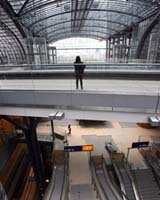
UPI Germany Correspondent Berlin (UPI) May 12, 2006 For the past 15 years, Berlin has been planning and building the largest, safest and most modern train station in Europe. Today a small army of orange-jacketed construction workers stream back and forth between track rails; hammering and screeching fills the air; and construction dust still covers the vaulted 351-yard long glass ceiling, through which, on opening day, light should flood unhindered into the brand-new Berlin Hauptbahnhof. Former Chancellor Helmut Kohl launched the construction project in October 1995, and his longtime prot�g�, German Chancellor Angela Merkel, will officially open the station on May 26. Located in the government district, the Hauptbahnhof -- formerly the Lehrter Bahnhof -- is the last of the expensive unification projects to be completed; other projects included the reconstruction of the Potsdamer Platz and the Reichstag parliament building. Planning for the station began in 1991, soon after Germany's reunification, in a bid to facilitate and centralize travel in the once divided city. West-bound passengers currently use the Zoo station; east-bounders mostly exit at the Ostbahnhof. The new main central station will put the two facilities virtually out of business. Taking up 1.9 million square feet, Hauptbahnhof will be Europe's largest train hub, serving 300,000 passengers with almost 1,100 long-distance, regional and local trains passing through daily, officials say. Hamburg-based architects Gerkan, Marg and Partner have incorporated stones from Austria and China, some 9,000 glass plates and six 30-person panorama elevators in the station's design. The five-level station cost Germany, the state of Berlin and German railway giant Deutsche Bahn some $890 million. But company spokeswoman Gabriele Schott said costs for the Bahn's new transport concept, which also included modernizing local train systems and opening no fewer than eight additional stations this month in Berlin and nearby Brandenburg, total a staggering $12.7 billion. "This is a small revolution for the Bahn," Schott said, leading a tour of the station. Standing in front of the station's main entrance, at the Invalidenstrasse, she said, with a sweep of her arm: "After German reunification, there was nothing here. The Hauptbahnhof has the chance to create a new center in downtown Berlin." The plaza in front of the main entrance in the north will be named Europe Square, while the vast area in front of the southern entrance, with a clear view of Merkel's chancellery, will be called Washington Square, she said. While the station will not link Europe with the United States, it will ease travel between Berlin and the rest of Germany, Schott said. Some 900 jobs (300 of them at Deutsche Bahn) have been created in the process. All 80 shops inside the station will be open to customers on May 26, Schott added, despite rumors that the Hauptbahnhof would not be finished in time for the grand opening. While security will be a focal point at the opening and during Merkel's visit, thorough measures will be a constant at Hauptbahnhof. Extensive precautions have been taken to combat such modern threats as terrorism, and to ensure passenger and mechanical security. The station's lowest level lies 22 yards below the ground; before construction could begin, experts scanned the soil for World War II bombs. "We found a massive amount of duds," Schott said. Inside the station, man-high security walls have been built between tracks, so that in the unlikely event of a derailment, passengers on other tracks will not be endangered. A third rail has been built adjacent to each track as an emergency fall-back rail. Officials had to update the station's security concept after the 1998 Eschede train accident, in which an ICE highspeed train derailed in Lower Saxonay, killing 101 people. The incident led to a massive overhaul of the German railway network. With recent terror attacks targeting mostly mass transit systems, officials are eager to make the Berlin Hauptbahnhof as safe as possible. Dozens of surveillance cameras will penetrate every corner of the station; the Bahn's security personnel will be on hand and Germany's federal police, the Bundespolizei, will have its own ward in the station. "Like any main transportation hub, security is a big factor," said Michael Baufeld, spokesman for security and customer service at the station. The new Hauptbahnhof will face its first big test in June, when Germany hosts the FIFA Soccer World Cup. Several games will be played in Berlin and nearby Leipzig, and officials expect a multitude of travelers during that time. Baufeld said there is a special service and security program for the World Cup. "We want to adhere to the World Cup's motto: 'A time to make friends,' so we want our guests to feel comfortable," Baufeld said. "But at the same time we will watch very closely what goes on."
Source: United Press International Community Email This Article Comment On This Article Related Links - Great Train Journey's of the 21st Century
 Japan Unveils New Bullet Train
 Tokyo (AFP) Apr 06, 2006
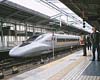
Japan on Wednesday unveiled a sleeker version of its celebrated bullet train, the Shinkansen, which is billed as being the fastest in the world. East Japan Railway Co. unveiled the latest prototype of the next-generation bullet train, code-named "Fastech 360Z," to the press on Wednesday at its rolling stock laboratory center near Sendai in northern Japan. |
|
|

| The content herein, unless otherwise known to be public domain, are Copyright 1995-2006 - SpaceDaily.AFP and UPI Wire Stories are copyright Agence France-Presse and United Press International. ESA PortalReports are copyright European Space Agency. All NASA sourced material is public domain. Additionalcopyrights may apply in whole or part to other bona fide parties. Advertising does not imply endorsement,agreement or approval of any opinions, statements or information provided by SpaceDaily on any Web page published or hosted by SpaceDaily. Privacy Statement |