|
 |
 |
 |
 |
 |
 |
 |
 |

 |
Behind The Headlines, UN Labs Test For Nuclear Violations
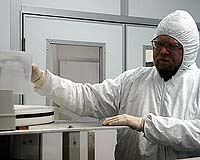
Seibersdorf, Austria (AFP) Nov 13, 2005 While headlines scream about Iran's nuclear program, UN scientists in white coats are quietly doing the high-tech laboratory work that may tell whether Tehran is secretly making atomic weapons. In block buildings standing in fields some 40 kilometres (25 miles) southeast of Vienna, the scientists use X-ray fluorescence, gamma spectrometry and other technology to filter out microsopic particles of uranium and plutonium in the hunt for isotopes that will show or disprove weapons work. "We can obtain a truly amazing amount of information from a tiny amount of materials in samples," said David Donohue, who heads the Clean Laboratory Unit of the UN watchdog International Atomic Energy Agency's Safeguards Analytical Laboratory . The samples are gathered by IAEA inspectors who visit nuclear or suspected nuclear sites. The inspectors swipe surfaces using a 10 X 10 centimeter square of specially clean cotton cloth to get what are called environmental samples, Donahue explained to reporters visiting the laboratory Friday. The samples are then analyzed at the IAEA and other laboratories in "clean" rooms, where air flow and hermetic seals maintain a contamination-free environment. White walls and floors are offset by the gleaming metal of machines like a secondary ion mass spectrometer which can provide a complete picture of the isotopic composition of uranium and plutonium from particles 100 times smaller than the width of a human hair. And this all comes from looking for dust. "We train our inspectors to look for dust" because that is where particles gather," Donahue said. He said gathering soil does not make for good sampling because there is too much organic material. "If the inspectors can not get into a building and have to sample from the outside, they should take samples from window sills, from road signs, any place dust collects," Donahue said, standing in front of the picture windows that give a full view of the clean rooms. Donahue said IAEA inspectors have honed their techniques since starting environmental sampling in Iraq in 1996. "We like to see dirty samples (full of dust traces). What we don't want to see is a kilogram of soil," Donahue said. In Iraq, inspectors brought back "whole trees" as they were looking for traces of tritium, a radioactive isotope of hydrogen, but this was not effective. "Inside buildings is better," Donahue said, explaining that the inspectors have learned to make structured searches, instead of just grabbing whatever they can. The Seibersdorf lab has already helped analyze samples taken at two sites in Iran and which have revealed traces of highly enriched uranium, which can be used to make nuclear weapons. But Iran, which says its nuclear program is a strictly peaceful effort to generate electricity, claims these particles were contamination that came along with equipment it imported and this claim is so far borne out by other evidence. The Seibersorf lab is currently handling a crucial step in the IAEA's investigation of Iran's nuclear program -- analyzing samples from the Parchin military site where Washington charges that the Islamic Republic is doing secret testing of implosion explosions of the type used in atomic bombs. Initial results have shown no signs of nuclear activity, diplomats told AFP Friday, although final results are not yet in. Final results are not expected until after a meeting November 24-25 in Vienna of the IAEA's 35-nation board of governors, which in September found Iran in non-compliance with the NPT. This opened the door to bring Iran before the UN Security Council, which could impose penalties such as trade sanctions to get Tehran to suspend all nuclear fuel work and cooperate fully with IAEA inspectors. Donahue said "some Parchin analysis has been done" at Seibersdorf but refused to say what the results were. He said Seibersdorf had more swipes to analyze and would be doing more intensive tests on swipes already run through spectrometry experiments. In addition, the IAEA is waiting for results from a second lab, in another country, to confirm the results. The Seibersdof facility is part of a network of 14 IAEA laboratories in eight countries. Donahue said IAEA inspectors take six swipes at a time so they have replicas and then have at least two analyzed, one in Seibersdorf, the other at another lab. The remaining samples are stored in archives at Seibersdorf. Donahue would not give the total number of swipes taken at Parchin on the last visit, November 1, but he said: "It's not hundreds." Community Email This Article Comment On This Article Related Links SpaceDaily Search SpaceDaily Subscribe To SpaceDaily Express Learn about nuclear weapons doctrine and defense at SpaceWar.com Learn about missile defense at SpaceWar.com All about missiles at SpaceWar.com Learn about the Superpowers of the 21st Century at SpaceWar.com
 World Powers Threaten Defiant Iran Over Nuclear Crisis
 Vienna (AFP) Jan 11, 2006
World powers threatened Iran with UN Security Council sanctions Wednesday after it resumed sensitive nuclear activities as a defiant Tehran vowed to press ahead with its disputed atomic programme. |
|
|

| The content herein, unless otherwise known to be public domain, are Copyright 1995-2006 - SpaceDaily.AFP and UPI Wire Stories are copyright Agence France-Presse and United Press International. ESA PortalReports are copyright European Space Agency. All NASA sourced material is public domain. Additionalcopyrights may apply in whole or part to other bona fide parties. Advertising does not imply endorsement,agreement or approval of any opinions, statements or information provided by SpaceDaily on any Web page published or hosted by SpaceDaily. Privacy Statement |