|
 |
 |
 |
 |
 |
 |
 |
 |

 |
Before Stars, Dark Matter Haloes Were First Objects In Early Universe
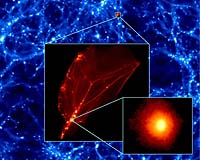
Zurich, Switzerland (SPX) Jan 31, 2005 Ghostly haloes of dark matter as heavy as the earth and as large as our solar system were the first structures to form in the universe, according to new calculations from scientists at the University of Zurich, published in last week's issue of Nature. Our own galaxy still contains quadrillions of these halos with one expected to pass by Earth every few thousand years, leaving a bright, detectable trail of gamma rays in its wake, the scientists say. Day to day, countless random dark matter particles rain down upon the Earth and through our bodies undetected. "These dark matter haloes were the gravitational 'glue' that attracted ordinary matter, eventually enabling stars and galaxies to form," said Prof. Ben Moore of the Institute for Theoretical Physics at the University of Zurich, a co-author on the Nature report. "These structures, the building blocks of all we see today, started forming early, only about 20 million years after the big bang." Dark matter comprises over 80 percent of the mass of the universe, yet its nature is unknown. It seems to be intrinsically different from the atoms that make up matter all around us. Dark matter has never been detected directly; its presence is inferred through its gravitational influence on ordinary matter. The Zurich scientists based their calculation on the leading candidate for dark matter, a theoretical particle called a neutralino, thought to have been created in the big bang. Their results entailed several months of number crunching on the zBox, a new supercomputer designed and built at the University of Zurich by Moore and Drs. Joachim Stadel and Juerg Diemand, co-authors on the report. "Until 20 million years after the big bang, the universe was nearly smooth and homogenous", Moore said. But slight imbalances in the matter distribution allowed gravity to create the familiar structure that we see today. Regions of higher mass density attracted more matter, and regions of lower density lost matter. Dark matter creates gravitational wells in space and ordinary matter flows into them. Galaxies and stars started to form as a result about 500 million years after the big bang, whereas the universe is 13.7 billion years old. Using the zBox supercomputer that harnessed the power of 300 Athlon processors, the team calculated how neutralinos created in the big bang would evolve over time. The neutralino has long been a favoured candidate for "cold dark matter," which means it does not move fast and can clump together to create a gravitational well. The neutralino has not yet been detected. This is a proposed "supersymmetric" particle, part of a theory that attempts to rectify inconsistencies in the standard model of elementary particles. For the past two decades scientists have believed that neutralinos could form massive dark matter haloes and envelope entire galaxies today. What has emerged from the Zurich team's zBox supercomputer calculation are three new and salient facts: Earth-mass haloes formed first; these structures have extremely dense cores enabling quadrillions to have survived the ages in our galaxy; also these "miniature" dark matter haloes move through their host galaxies and interact with ordinary matter as they pass by. It is even possible that these haloes could perturb the Oort cometary cloud far beyond Pluto and send debris through our solar system. "Detection of these neutralino haloes is difficult but possible", the team said. The halos are constantly emitting gamma rays, the highest-energy form of light, which are produced when neutralinos collide and self-annihilate. "A passing halo in our lifetime (should we be so lucky), would be close enough for us to easily see a bright trail of gamma rays," said Diemand, now at the University of California at Santa Cruz. The best chance to detect neutralinos, however, is in galactic centres, where the density of dark matter is the highest, or in the centres of these migrating Earth-mass neutralino haloes. Denser regions will provide a greater chance of neutralino collisions and thus more gamma rays. "This would still be difficult to detect, like trying to see the light of a single candle placed on Pluto," said Diemand. NASA's GLAST mission, planned for launch in 2007, will be capable of detecting these signals if they exist. Ground-based gamma-ray observatories such as VERITAS or MAGIC might also be able to detect gamma rays from neutralino interactions. In the next few years the Large Hadron Collider at CERN in Switzerland will confirm or rule out the concepts of supersymmetry. Community Email This Article Comment On This Article Related Links SpaceDaily Search SpaceDaily Subscribe To SpaceDaily Express Nuclear Space Technology at Space-Travel.com
 JHU-STScI Team Maps Dark Matter In Startling Detail
 Baltimore MD (SPX) Dec 12, 2005
Clues revealed by the recently sharpened view of the Hubble Space Telescope have allowed astronomers to map the location of invisible "dark matter" in unprecedented detail in two very young galaxy clusters. |
|
|

| The content herein, unless otherwise known to be public domain, are Copyright 1995-2006 - SpaceDaily.AFP and UPI Wire Stories are copyright Agence France-Presse and United Press International. ESA PortalReports are copyright European Space Agency. All NASA sourced material is public domain. Additionalcopyrights may apply in whole or part to other bona fide parties. Advertising does not imply endorsement,agreement or approval of any opinions, statements or information provided by SpaceDaily on any Web page published or hosted by SpaceDaily. Privacy Statement |