|
 |
 |
 |
 |
 |
 |
 |
 |

 |
Before Fossil Fuels, Earth's Minerals Kept CO2 In Check
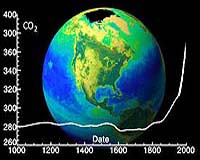
Stanford CA (SPX) May 01, 2008 Over millions of years carbon dioxide levels in the atmosphere have been moderated by a finely-tuned natural feedback system- a system that human emissions have recently overwhelmed. A joint University of Hawaii / Carnegie Institution study published in the advance online edition of Nature Geoscience links the pre-human stability to connections between carbon dioxide in the atmosphere and the breakdown of minerals in the Earth's crust. While the process occurs far too slowly to have halted the historical buildup of carbon dioxide from human sources, the finding gives scientists new insights into the complexities of the carbon cycle. Ken Caldeira of the Carnegie Institution's Department of Global Ecology and Richard Zeebe of the University of Hawaii studied levels of carbon dioxide in the atmosphere over the past 610,000 years using data from gas bubbles trapped in Antarctic ice cores. They used these records, plus geochemical data from ocean sediments, to model how carbon dioxide released into the atmosphere by volcanoes and other natural sources is ultimately recycled via carbon-bearing minerals back into the crust. When carbon dioxide levels in the atmosphere rise, the chemical reactions that break down silicate minerals in soils are accelerated. Among the products of these reactions are calcium ions, which dissolve in water and are washed to the ocean by rivers. Marine organisms such as mollusks combine the calcium ions with dissolved carbon dioxide to make their shells (calcium carbonate), which removes both calcium and carbon dioxide from the ocean, restoring the balance. The researchers found that over hundreds of thousands of years the equilibrium between carbon dioxide input and removal was never more than one to two percent out of balance, a strong indication of a natural feedback system. This natural feedback acts as a thermostat which is critical for the long-term stability of climate. During Earth's history it has probably helped to prevent runaway greenhouse and icehouse conditions over time scales of millions to billions of years - a prerequisite for sustaining liquid water on Earth's surface. "The system is finely in tune," says Caldeira. "That one or two percent imbalance works out to an average imbalance in natural carbon dioxide emissions that is thousands of times smaller than our current emissions from industry and the destruction of forests." Previous researchers had suggested that such a system existed, but Caldeira and Zeebe's study provides the first observational evidence supporting the theory, and confirms its role in stabilizing the carbon cycle. But because it operates over such a long time scale-the time scale over which landscapes are eroded and washed to the sea-this geological feedback system offers little comfort with respect to the current climate crisis. Carbon dioxide is added naturally to the atmosphere and oceans from volcanoes and hydrothermal vents at a rate of about 0.1 billion tons of carbon each year. Human industrial activity and destruction of forests is adding carbon about 100 times faster, approximately 10 billion tons of carbon each year. "The imbalance in the carbon cycle that we are creating with our emissions is huge compared to the kinds of imbalances seen over the time of the glacial ice core records," says Caldeira. "We are emitting CO2 far too fast to expect mother nature to mop up our mess anytime soon. Continued burning of coal, oil and gas will result in long-term changes to our climate and to ocean chemistry, lasting many thousands of years." Community Email This Article Comment On This Article Related Links Carnegie Institution Climate Science News - Modeling, Mitigation Adaptation
 Global warming? Next decade could be cooler, says study
 Paris (AFP) April 30, 2008
Global warming could take a break in the next decade thanks to a natural shift in ocean circulations, although Earth's temperature will rise as previously expected over the longer term, according to a study published on Thursday in the British journal Nature. |
|
|

| The content herein, unless otherwise known to be public domain, are Copyright 1995-2007 - SpaceDaily.AFP and UPI Wire Stories are copyright Agence France-Presse and United Press International. ESA Portal Reports are copyright European Space Agency. All NASA sourced material is public domain. Additional copyrights may apply in whole or part to other bona fide parties. Advertising does not imply endorsement,agreement or approval of any opinions, statements or information provided by SpaceDaily on any Web page published or hosted by SpaceDaily. Privacy Statement |