|
 |
 |
 |
 |
 |
 |
 |
 |

 |
Bees Are The New Silkworms
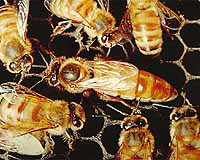
Canberra, Australia (SPX) Nov 27, 2007 Moths and butterflies, particularly silkworms, are well known producers of silk. And we all know spiders use it for their webs. But they are not the only invertebrates who make use of the strength and versatility of silk. Dr Tara Sutherland and her group from CSIRO Entomology are looking at silks produced by other insects and the results of their recent work have been published in Molecular Biology and Evolution, in the paper Conservation of Essential Design Features in Coiled Coil Silks. "Most people are unaware that bees and ants produce silk but they do and its molecular structure is very different to that of the large protein, sheet structure of moth and spider silk. The cocoon and nest silks we looked at consist of coiled coils - a protein structural arrangement where multiple helices wind around each other. This structure produces a light weight, very tough silk," she says. "We had already identified the honeybee silk genes," says Dr Sutherland, "and now we have identified and sequenced the silk genes of bumblebees, bulldog ants and weaver ants, and compared these to honeybee silk genes. This let us identify the essential design elements for the assembly and function of coiled coil silks". "To do this, we identified and compared the coiled coil proteins from cocoon and nest silks from species which span the evolutionary tree of the social Hymenoptera (bees, ants and wasps)," she says. Bees and ants produce high-performance silk and, although the silks in all these species are produced by the larvae and by the same glands, they use them differently. Honeybee larvae produce silk to reinforce the wax cells in which they pupate, bulldog ant larvae spin solitary cocoons for protection during pupation, bumblebee larvae spin cocoons within wax hives (the cocoons are reused to store pollen and honey), and weaver ants use their larvae as 'tools' to fasten fresh plant leaves together to form large communal nests.. These groups of insects have evolved silks that are very tough and stable in comparison to the classical sheet silks and it is probable that the evolution of this remarkable material has underpinned the success of the social Hymenoptera. Coiled coil silks are common in aculeate social insects i.e. those that have stings but not in aculeate parasitic wasps. These social insects are higher up the evolutionary tree and the coiled coil silks appear to have evolved about 155 million years ago. The silk research is part of the joint CSIRO and Grains Research and Development Corporation (GRDC) Crop Biofactories Initiative (CBI). Community Email This Article Comment On This Article Related Links
 Cyprian Honeybees Kill Their Enemy By Smothering Them
 Thessaloniki, Greece (SPX) Sep 19, 2007
For the first time, researchers have discovered that when Cyprian honeybees mob and kill their arch enemy, the Oriental hornet, the cause of death is asphyxiation. They reported their findings in the September 18, 2007, issue of Current Biology, a publication of Cell Press. |
|
|

| The content herein, unless otherwise known to be public domain, are Copyright 1995-2007 - SpaceDaily.AFP and UPI Wire Stories are copyright Agence France-Presse and United Press International. ESA Portal Reports are copyright European Space Agency. All NASA sourced material is public domain. Additional copyrights may apply in whole or part to other bona fide parties. Advertising does not imply endorsement,agreement or approval of any opinions, statements or information provided by SpaceDaily on any Web page published or hosted by SpaceDaily. Privacy Statement |