|
 |
 |
 |
 |
 |
 |
 |
 |

 |
Ball To Develop Aerocapture Under NASA Propulsion Study
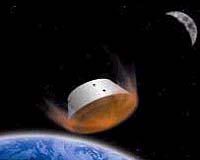
Boulder - June 12, 2003 NASA recently selected Ball Aerospace & Technologies Corp. to pursue advances in ballute aerocapture, an in-space propulsion innovation. Ball Aerospace was one of 15 organizations chosen to pursue 22 propulsion technology research proposals totaling $20 million that NASA says could revolutionize exploration and scientific study of the solar system. These awards are part of the In-Space Propulsion Technologies, Cycle 2, which is designed to increase the efficiency of space missions and enable new missions that are impossible or impractical with current propulsion technologies. "Ballute aerocapture is really on the cutting edge of space technology right now, and we feel very fortunate to be involved with NASA at this early stage in its development," says Harold Reitsema, director of Space Sciences Advanced Programs at Ball Aerospace. "This technology will reduce the cost of planetary exploration, and increase the opportunity to gather valuable scientific data about planets we've previously been unable to study." Aerocapture uses atmospheric drag to slow down an incoming satellite so that it enters an orbit around a planetary body more efficiently. Like a drag racer's parachute, the satellite is equipped with a "ballute," a combination of balloon and parachute, which slows the satellite enough to go into orbit around the target planet. Attached ballutes also protect the satellite and its payload from the extreme environment encountered while entering the orbit by deflecting heat. The most important advantage of aerocapture is that it reduces the amount of propellant required to send a satellite into its proper orbit. This lowers launch costs and allows more room on the spacecraft for scientific payloads. Because of the fuel savings and lower-cost launches, aerocapture techniques will allow scientists to study more types of planetary bodies, including Neptune, and Titan, the largest moon of Saturn. The technique chosen for the NASA contracts leverages previous, successful aerocapture work contracted to Ball Aerospace over the past few years. The new contract includes concept development and hypersonic testing of materials. Ball Corporation is one of the world's leading suppliers of metal and plastic packaging to the beverage and food industries. The company also owns Ball Aerospace & Technologies Corp. With the addition of Ball Packaging Europe, acquired in December 2002, Ball expects to report 2003 sales of approximately $5 billion, of which approximately $4.5 billion will come from its two packaging segments and $500 million from its aerospace and technologies segment. Community Email This Article Comment On This Article Related Links Ball Aerospace & Technologies SpaceDaily Search SpaceDaily Subscribe To SpaceDaily Express Rocket Science News at Space-Travel.Com
 Successful First Test For Vega's Zefiro 9 Engine
 Paris, France(ESA) Dec 28, 2005
Flames, smoke and a deafening noise accompanied the first firing test of Vega's Zefiro 9 third-stage solid rocket motor. A first examination of the data indicates that everything went well at the test carried out yesterday at Salto de Quirra in southeast Sardinia. |
|
|

| The content herein, unless otherwise known to be public domain, are Copyright 1995-2006 - SpaceDaily.AFP and UPI Wire Stories are copyright Agence France-Presse and United Press International. ESA PortalReports are copyright European Space Agency. All NASA sourced material is public domain. Additionalcopyrights may apply in whole or part to other bona fide parties. Advertising does not imply endorsement,agreement or approval of any opinions, statements or information provided by SpaceDaily on any Web page published or hosted by SpaceDaily. Privacy Statement |