|
 |
 |
 |
 |
 |
 |
 |
 |

 |
Balancing Science and Engineering Is Like Dancing the Tango
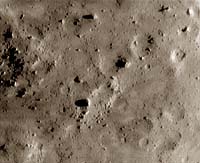
Laurel - October 17, 2000 NEAR is now eight months into its year-long rendezvous with Eros. We have seen Eros from as low as 35 km orbit for about ten days back in July, but then returned to higher altitude. For the last five weeks, we have been mapping Eros from 100 km orbit, but we are now preparing for our closest descent yet, a 6 km flyover scheduled for October 25, 2000. Why has NEAR Shoemaker performed this elaborate tango with Eros? One answer is that we chose one of the most attractive partners on the dance floor, and we have to pay the price if we wish to dance very close - it costs extra fuel and requires frequent maneuvers. But another reason for dancing both up close and farther out is that we scientists want it that way. The design of the mission has been the result of a complicated interplay between science and engineering requirements. To start with, NEAR Shoemaker was designed as a simple spacecraft, with fixed antennas, fixed solar panels, and fixed instruments. This simplicity makes for a more reliable and robust spacecraft, but it also places operational constraints on the mission. The spacecraft must always keep its solar panels pointed at the sun - it cannot survive even for an hour without solar power, not only because the electronics would stop operating, but also because instruments and subsystems would be damaged by cold and the fuel would quickly freeze. The instruments must be pointed at the asteroid in order to acquire data. The main antenna must be pointed at Earth to send data back to Earth at high rate, although the spacecraft status can be monitored and the spacecraft can be tracked at lower data rates using other antennas, even when the main antenna is not pointed at Earth. If we had designed a more complex spacecraft, we could have lifted many or all of the operational constraints, but it would have cost more. And indeed these restrictions complicate the day-to-day operations of the spacecraft, but it turns out that the ever-vigilant enforcement of simple rules is a task better suited for computers than for humans, and this task is largely automated for NEAR. Paradoxically, the use of a simple spacecraft leads to an overall simplification of mission operations, despite operational restrictions, because there are fewer options to be studied. In any case, the spacecraft design constrains NEAR Shoemaker to fly in an orbit plane that is within about 30 degrees of perpendicular to the line from Eros to the Sun. The spacecraft can then keep its solar panels pointed at or close enough to the Sun at all times, while for 16 hours a day it keeps the instruments pointed at Eros for data taking, and for 8 hours a day it points the main antenna at Earth for data transmission. This tight constraint on the orbit plane at Eros, plus the constraint that the orbit is flown at a particular time, already fairly well settle three of the six parameters required to specify an orbit completely. In some sense the orbit is now almost halfway designed, although in real life our engineers determine these parameters to 10 decimal places. Those of us who don't actually have to fly the spacecraft can afford to take a more relaxed attitude. The remaining three orbit parameters deal with how low and how high the orbit goes, and precisely where it dips low. That is where science comes in, although even at this point operational constraints are still critical. Some of our science operations are best performed at higher altitudes, while others require that the spacecraft be at low altitude. For instance, our imaging team desires to map the whole asteroid under a variety of lighting conditions and from a series of orbit radii, specifically 200 km, 100km, and 50 km. In addition, the team requires both monochrome (black-and-white) and color imaging, and the ideal lighting conditions for the one are not ideal for the other. For monochrome images, we prefer the sun to be low in the sky so that shadows accentuate the structures, whereas for color images we prefer the sun to be higher to reduce the shadowing. In addition, there are seasons on the asteroid. Until late June of this year, portions of the southern hemisphere never came into sunlight at all. The reverse is now true in the southern hemisphere summer, when the north polar region is always in the dark. Beyond all these requirements, the x-ray and gamma ray teams need to have the spacecraft in low orbits of 50 km or less as long as possible to achieve the highest possible signal-to-noise ratio. Also the laser rangefinder team obtains the highest resolution and measurement accuracy in the low orbits, and the study of the asteroid's interior structure, through determination of its gravity and magnetic fields, achieves the highest sensitivity in the low orbits. So there are many science tasks that require low orbits, but there are also science tasks that require high orbits, and in both cases, the spacecraft is required to fly over all parts of the asteroid at the altitudes in question. In addition, particular solar illumination geometries are often required, such as for color and spectral observations as well as the x-ray measurements. Hence the choices of how low to fly, and where, and when, are complicated, and we really needed to spend a full year at Eros. Moreover, there are engineering requirements which derive from orbit stability. The spacecraft cannot be put into an orbit that would be so unstable that we could not predict with sufficient accuracy where it would be a week later, or so unstable that, if for any reason we could not contact the spacecraft or correct its orbit for a week, it would crash or escape from the asteroid. Furthermore, we avoid orbits that would require excessive fuel expenditures or corrective maneuvers more often than once a week. Finally, we cannot send the spacecraft into an orbit that would carry it into the shadow of the asteroid, where the Sun would be eclipsed and the spacecraft would die. Generally speaking, the orbits we need to worry about are the low orbits. As we discussed earlier (April 18, 2000), the irregularity of an object's shape produces greater and greater distortions of its gravity field, the closer one approaches to the object. At large distances from any object, its gravity field becomes monopolar and spherical, so higher orbits tend to be better behaved in terms of being more like ordinary elliptical orbits. There is a caveat, which is that the gravity from the object must remain the biggest force field around; if we get too far from the object, then we also have to worry about other forces like solar gravity and radiation pressure, and orbits become complicated again. For Eros, too high in this sense means above about 1000 km. Hence the 200 km orbits are fairly stable and ordinary - that is, not too close and not too far. The 50 km orbits, on the other hand, are close enough to be strongly perturbed by the irregular shape of Eros. The most serious disturbance is that the orbit plane is continually torqued around (that is, it precesses), so it would quickly violate the operational constraint we started with unless we perform maneuvers to correct the orbit. In other words, we need to fire the rocket engines to keep the orbit plane within the allowed angles to the line from Eros to the Sun. It turns out that the precession rate depends on the orbital inclination to the Eros equator as well as the orbital radius. The upshot is, there are only certain times of year when NEAR Shoemaker can fly in 50 km orbits or lower, without using too much fuel or putting the spacecraft at too much risk. Even so, we have no choice but to get up close to Eros to make the measurements we need. This is why we are dancing a tango with Eros, sometimes close, and sometimes far. Like the real tango, our dance with Eros has been exciting, full of mystery, and much hard work - and more is still to come. Our closest view of the surface to date is eight days away. Community Email This Article Comment On This Article Related Links NEAR Mission SpaceDaily Search SpaceDaily Subscribe To SpaceDaily Express Nuclear Space Technology at Space-Travel.com
 Eros Space Science Begins To Take Shape
 Cameron Park - August 20, 2001
The "NEAR" spacecraft has just completed a highly successful mission providing us with our first prolonged and close up view of an asteroid. |
|
|

|
|
|
|
|
|
|
|
|
|
|
|
| The content herein, unless otherwise known to be public domain, are Copyright 1995-2006 - SpaceDaily.AFP and UPI Wire Stories are copyright Agence France-Presse and United Press International. ESA PortalReports are copyright European Space Agency. All NASA sourced material is public domain. Additionalcopyrights may apply in whole or part to other bona fide parties. Advertising does not imply endorsement,agreement or approval of any opinions, statements or information provided by SpaceDaily on any Web page published or hosted by SpaceDaily. Privacy Statement |