|
 |
 |
 |
 |
 |
 |
 |
 |

 |
Bacterial 'Switch Gene' Regulates How Oceans Emit Sulfur Into Atmosphere
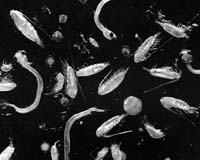
Athens GA (SPX) Oct 30, 2006 Scientists have discovered a bacterial "switch gene" in two groups of microscopic plankton common in the oceans. The gene helps determine whether certain marine plankton convert a sulfur compound to one that rises into the atmosphere, where it can affect the earth's temperature, or remain in the sea, where it can be used as a nutrient. "This new gene offers a powerful tool to study the question of how these plankton are involved with sulfur exchange between the ocean and atmosphere," said Mary Ann Moran, marine microbial ecologist at the University of Georgia. Moran and her colleagues published their findings in the Oct. 26, 2006, issue of the journal Science. Much of the sulfur in the atmosphere comes from the surface of oceans, from a compound called dimethlysulfide, or DMS. Marine plankton control how much sulfur rises into the atmosphere by converting a compound called DMSP, or dimethylsulfoniopropionate, to DMS or to sulfur compounds that are not climatically active. Moran and her team discovered a gene that controls whether or not these sea drifters create DMS that rises into the air. "Isolating and discovering a novel, keystone bacterium from the ocean first, and then sequencing its genome enabled this team to find the genes involved in the DMSP cycle," said Matthew Kane, program director in the National Science Foundation (NSF) Division of Molecular and Cellular Biosciences, which supported the research. "The research has revealed the previously hidden role that marine microbes play in the global sulfur cycle." The researchers discovered that microscopic plankton that fall under the Roseobacter and SAR11 organism groups are the primary plankton involved in directing DMSP away from forming DMS, and thus making sulfur unavailable to atmospheric processes. Dramatic advances in understanding how these plankton work have developed in the past few years with the availability of new genomic data. The scientists searched genome fragments of these plankton, looking for specific gene sequences that would show how the plankton use sulfur compounds. "This breakthrough in the microbial physiology of DMSP metabolism opens the door to understanding the biology and ecology of this globally important process," said William Whitman, a microbiologist at the University of Georgia and co-author of the Science paper. The discovery of a bacterial gene switch in these two groups of plankton will open new areas of research, since DMSP synthesis may account for almost all marine-created atmospheric sulfur. The findings also expand knowledge of how these marine organisms are involved in the routing of carbon and sulfur into the microbial food web. Community Email This Article Comment On This Article Related Links University of Georgia Learn about Climate Science at TerraDaily.com Climate Science News - Modeling, Mitigation Adaptation
 Kyoto Protocol Countries Launch New Move On Greenhouse Gases
 Paris (AFP) Oct 26, 2006
Countries that have ratified the UN's Kyoto Protocol launched a new incentive on Thursday to help tackle greenhouse gas emissions by former Soviet bloc economies. The final decisions completing the Joint Implementation (JI) initiative were made in Bonn by a supervisory committee under the UN Framework Convention on Climate Change (UNFCCC), Kyoto's parent treaty. |
|
|

| The content herein, unless otherwise known to be public domain, are Copyright 1995-2006 - SpaceDaily.AFP and UPI Wire Stories are copyright Agence France-Presse and United Press International. ESA PortalReports are copyright European Space Agency. All NASA sourced material is public domain. Additionalcopyrights may apply in whole or part to other bona fide parties. Advertising does not imply endorsement,agreement or approval of any opinions, statements or information provided by SpaceDaily on any Web page published or hosted by SpaceDaily. Privacy Statement |