|
 |
 |
 |
 |
 |
 |
 |
 |

 |
Bacteria Could Steady Buildings Against Earthquakes
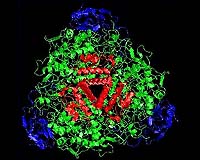
Davis CA (SPX) Feb 22, 2007 Soil bacteria could be used to help steady buildings against earthquakes, according to researchers at UC Davis. The microbes can literally convert loose, sandy soil into rock. When a major earthquake strikes, deep, sandy soils can turn to liquid, with disastrous consequences for buildings sitting on them. Currently, civil engineers can inject chemicals into the soil to bind loose grains together. But these epoxy chemicals may have toxic effects on soil and water, said Jason DeJong, an assistant professor of civil and environmental engineering at UC Davis. The new process, so far tested only at a laboratory scale, takes advantage of a natural soil bacterium, Bacillus pasteurii. The microbe causes calcite (calcium carbonate) to be deposited around sand grains, cementing them together. By injecting bacterial cultures, additional nutrients and oxygen, DeJong and his colleagues found that they could turn loose, liquefiable sand into a solid cylinder. "Starting from a sand pile, you turn it back into sandstone," DeJong said. Similar techniques have been used on a smaller scale, for example, to repair cracks in statues, but not to reinforce soil. The new method has several advantages, DeJong said. There are no toxicity problems, compared with chemical methods. The treatment could be done after construction or on an existing building, and the structure of the soil is not changed -- some of the void spaces between grains are just filled in. DeJong and his collaborators are working on scaling the method up to a practical size, and applying for funds to test the method in the earthquake-simulating centrifuge at UC Davis' Center for Geotechnical Modeling. The centrifuge is part of the national Network for Earthquake Engineering Simulation, funded by the National Science Foundation. A paper describing the work has been published in the Journal of Geotechnical and Geoenvironmental Engineering. The other authors are Michael Fritzges, a senior engineer at Langan Engineering, Philadelphia; and Klaus Nusslein, associate professor of microbiology at the University of Massachusetts, Amherst. The work was supported by the National Science Foundation. Community Email This Article Comment On This Article Related Links University of California- Davis Bring Order To A World Of Disasters Bringing Order To A World Of Disasters A world of storm and tempest When the Earth Quakes
 Indonesia Delays Start Of Plan To Plug Mud Volcano
 Jakarta (AFP) Feb 21, 2007
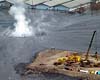
Indonesian authorities Wednesday postponed the start of an attempt to slow a massive mudflow which has swallowed villages by plugging the crater with chains of concrete balls. A gas well near Surabaya in East Java has spewed steaming mud since May last year, submerging villages, factories and fields and forcing more than 15,000 people to flee their homes. |
|
|

| The content herein, unless otherwise known to be public domain, are Copyright 1995-2006 - SpaceDaily.AFP and UPI Wire Stories are copyright Agence France-Presse and United Press International. ESA PortalReports are copyright European Space Agency. All NASA sourced material is public domain. Additionalcopyrights may apply in whole or part to other bona fide parties. Advertising does not imply endorsement,agreement or approval of any opinions, statements or information provided by SpaceDaily on any Web page published or hosted by SpaceDaily. Privacy Statement |