
 |
 |
 |
 |
 |
 |
 |
 |
 |

 |
B-52: Lifespan Of A Raven
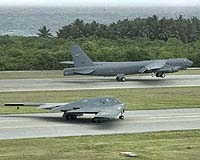
RIA Novosti military commentator Moscow (RIA Novosti) Jul 25, 2008 The B-52 bomber that crashed in the Pacific Ocean near the island of Guam was the third plane of the U.S. Air Force's strategic aviation to be lost in the last six months. The fact that expensive heavy bombers fall so often raises doubts over the Air Force's battle readiness in general. (INFOgraphic) In February 2008, a B-2 stealth bomber crashed shortly after takeoff from the Andersen Air Force base in Guam. In April, a B-1B strategic bomber exploded after landing at the Al-Udeid Air Base in the United Arab Emirates. Even though the immediate cause for the crash of B-52 has not been named yet, it is likely to have something to do with its venerable age. These planes went into mass production in 1953-1963, and B-52H planes entered operational service in 1960-1963, making their average age about 47 years. The B-52 has been repeatedly modernized, but the modernization that improved the plane's equipment and weapons could not give new life to the worn-out superstructure, while capital repairs can prolong the life of the plane but not make it immortal. At the same time, however, the B-52 is not on the way out as a combat vehicle because there is no adequate substitute available. Indeed, it is likely to stay in service up to 2040's. This seems absurd, especially when the U.S. has developed several types of strategic bombers to replace the B-52. Its first attempt was the XB-70 Valkyrie, but this supersonic bomber turned out to be too expensive and the program was cancelled. The second was the B-1A bomber developed in 1960-1970's. However, by the late 70's this plane, which was equipped only with bombs, seemed to be obsolete. Instead, the U.S. started developing the B-1B. But even the modernized version could not carry ALCM long-range standoff attack missiles, but only shorter-range SRAM missiles. As a result, the B-52H equipped with long-range missiles remained the main strategic workhorse of the U.S. Air Force. Moreover, in accordance with the Soviet-American agreements on nuclear weapon reduction, the B-1B lost its SRAM missiles, which were eliminated, and since then has been carrying only bombs (although the U.S. is planning to bring into service the new JASSM cruise missile). The last strategic bomber to be developed was the B-2, which went into production in the beginning of the 1990's. But this replacement for the B-52 turned out to be too expensive even for the American budget - one aircraft cost about $1.5 bn. As a result, the U.S. only produced 20 B-2s and kept the B-52 in service. At this moment there is no alternative to the B-52. It is the only aircraft that can fulfill all the tasks of strategic aviation, from carpet-bombing to strikes on well-protected targets using long-range high-accuracy missiles. The development of a new aircraft that would replace all thee planes is at the pre-design stage. Taking into account the terms and the cost of modern planes, it is possible that the B-52, like its Russian counterpart the Tu-95, will celebrate the 100th anniversary of its operational service. We don't have to wait long - only until 2055. The opinions expressed in this article are the author's and do not necessarily represent those of RIA Novosti.
Source: RIA Novosti Community Email This Article Comment On This Article Share This Article With Planet Earth
Related Links The latest in Military Technology for the 21st century at SpaceWar.com
 India to train US 'Green Berets' in jungle warfare
 Guwahati, India (AFP) July 26, 2008
A contingent of US Special Forces, or Green Berets, will team up with Indian soldiers to train in jungle warfare, officials said on Saturday. |
|
|

| The content herein, unless otherwise known to be public domain, are Copyright 1995-2007 - SpaceDaily.AFP and UPI Wire Stories are copyright Agence France-Presse and United Press International. ESA Portal Reports are copyright European Space Agency. All NASA sourced material is public domain. Additional copyrights may apply in whole or part to other bona fide parties. Advertising does not imply endorsement,agreement or approval of any opinions, statements or information provided by SpaceDaily on any Web page published or hosted by SpaceDaily. Privacy Statement |
 del.icio.us
 Digg
Digg Reddit
 YahooMyWeb
 Google
 Facebook