|
 |
 |
 |
 |
 |
 |
 |
 |

 |
BMD Can Backfire On Europe
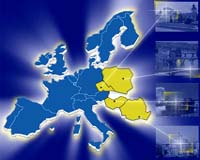
UPI Outside VIew Commentator Moscow, Russia (UPI) Feb 21, 2007 What does Europe stand to gain, or lose, from the forthcoming deployment of American antiballistic missile systems in Poland and the Czech Republic? Officially, they are supposed to protect Europe from the missiles of "rogue" countries (such as North Korea and Iran). If this explanation weren't already as believable as Santa Clause, the facts, including geography, ballistics, and the data provided by all major intelligence agencies, serve to discredit it even further. "Rogue" countries do not have the kinds of missiles the system was meant to protect against, and even if they did have them, the systems should not be deployed in the projected areas. I am not going to discuss American reasoning here, because it is much more interesting to see what Europe may gain or lose from the implementation of the United States' plans. Europe's only gain from it will be Washington's applause for doing "the right thing," applause that can be converted into something more profitable, though not security. The dissolution of the Soviet Union and the Warsaw Pact strengthened the security of Western Europe to an unprecedented level. The Soviet Union liquidated its intermediate- and shorter-range missiles which had been targeted at Europe, and reduced its heavy weaponry (tanks, armored vehicles and artillery systems), which were the dominant force deployed in the direction of the West. These and several other conciliatory actions gave the world a chance to become a safer place. Unfortunately, the world has not taken advantage of that chance. The West has not honored its commitments to the Soviet Union and Russia's first president, Boris Yeltsin. Former members of the Warsaw Pact have joined NATO, which is advancing closer to the borders of Russia with every passing year. The West has also violated the limits set for conventional heavy weaponry. The admission of Bulgaria and Romania to NATO increased the bloc's reserves by 1,250 tanks, some 2,700 armored vehicles and 1,600 artillery systems above the flank limits. Together with the other new members, NATO has now exceeded the limits stipulated in the Conventional Forces in Europe treaty by 5,992 combat tanks, 8,882 armored vehicles, 5,171 artillery systems, 1,497 combat aircraft, and 515 strike helicopters. Does the Kremlin have any use for such a conventional forces treaty, especially if NATO can now monitor Russia's armed forces in real time? It is therefore not surprising that Russia has decided to respond. General of the Army Yuri Baluyevsky, chief of the Russian General Staff, has recently mentioned the possibility of Moscow withdrawing from the CFE and the Intermediate-Range Nuclear Forces treaties. Russian President Vladimir Putin has said openly that Russia would respond to the U.S. deployment of ABM systems in Poland and the Czech Republic, though not in kind. In other words, it will not build a new ballistic missile system, whose effectiveness could in any case not be proved without live tests, but will use missiles that can evade such systems, which it already has. So, has Europe gained or lost? Has life on the continent become safer under America's leaky umbrella, with Russian missiles on combat duty round the clock? Would it have been better off without either? The answer seems apparent to me. Why then have Poland and the Czech Republic agreed to house American ABM systems, and why is NATO building up its military muscle? Does it want to intimidate Moscow? The United States is a great power, but it is not God Almighty, and when it makes mistakes it makes them in a big way. Why recreate problems the world has worked so hard to solve? Pyotr Romanoov is a political commentator for the RIA Novosti news agency. This article is reprinted by permission of RIA Novosti. The opinions expressed in this article are those of the author and may not necessarily represent the opinions of the editorial board.
Source: United Press International
Community Email This Article Comment On This Article Related Links Learn about missile defense at SpaceWar.com Learn about missile defense at SpaceWar.com Learn about nuclear weapons doctrine and defense at SpaceWar.com All about missiles at SpaceWar.com Learn about the Superpowers of the 21st Century at SpaceWar.com
 Putin Pledges To Strengthen Russia's Defense Potential
 Moscow, Russia (RIA Novosti) Feb 23, 2007
Russian President Vladimir Putin said Wednesday that although Russia does not pose a threat to any other country, it will continue to build its defense potential to guarantee its own security. Putin addressed the participants of a meeting in the Kremlin on the eve of Defenders of the Fatherland Day, and praised the latest achievements in the development of the Russian Armed forces while pledging strong state support for the military. |
|
|

| The content herein, unless otherwise known to be public domain, are Copyright 1995-2006 - SpaceDaily.AFP and UPI Wire Stories are copyright Agence France-Presse and United Press International. ESA PortalReports are copyright European Space Agency. All NASA sourced material is public domain. Additionalcopyrights may apply in whole or part to other bona fide parties. Advertising does not imply endorsement,agreement or approval of any opinions, statements or information provided by SpaceDaily on any Web page published or hosted by SpaceDaily. Privacy Statement |