|
 |
 |
 |
 |
 |
 |
 |
 |

 |
BAE Systems Microprocessors Enroute To Mars
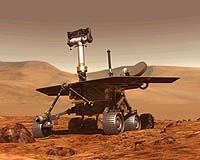
Nashua - Jul 29, 2003 NASA's two Mars Exploration Rovers now on route to Mars are outfitted with BAE SYSTEMS radiation-hardened RAD6000 computers that will process and send data back to earth to help NASA search for evidence about ancient water on Mars. The first launch occurred June 10 from Kennedy Space Center. That Rover, named "Spirit," is expected to land south of Mars' equator on Jan. 4, while the second spacecraft, named "Opportunity" was launched July 7 and will land on the other side of the planet Jan. 25. Both spacecraft will descend to the red planet using rockets, parachutes, and inflatable balloons. Once on the surface the solar-powered Rovers, Spirit and Opportunity, will drive off their landers to begin studying minerals in rocks. They'll travel up to 132 feet each day and operate at temperatures dropping to down to minus 100 degrees centigrade at night. As Spirit and Opportunity move about the surface searching for clues to past environments of Mars, robotic tools on the Rovers will investigate interesting rocks and other geological formations. "The navigation of the Rovers and the scientific analysis require 'brainpower,'" said Tom Bowmaster, BAE SYSTEMS program manager for the Information & Electronic Warfare Systems (IEWS) unit. "The RAD6000 truly is the 'brains' of the Rover and can process more than 20 million software instructions per second to perform this complex mission," he said. The RAD6000 is a high-performance 32-bit Reduced Instruction Set Computer (RISC) that provides powerful and flexible solutions for space applications. Since 1995, IEWS' facility in Manassas, Va., has delivered more than 300 radiation-hardened computers that have been launched and operated in space. The RAD6000 was also the single control and data computer used on the successful Pathfinder mission, which landed on Mars in 1997. The RAD6000 is one of a family of radiation-hardened computers developed and produced by BAE SYSTEMS with the support of NASA's Jet Propulsion Laboratory, the Air Force Research Laboratory and other Department of Defense organizations. Community Email This Article Comment On This Article Related Links BAE Systems SpaceDaily Search SpaceDaily Subscribe To SpaceDaily Express Space Technology News - Applications and Research
 Industry Team Achieve New Communications Technology With AESA Radars
 Baltimore MD (SPX) Jan 12, 2006
A team comprised of three leading US aerospace and defense contractors has demonstrated an innovative technological use of active electronically scanned array (AESA) radars for high-bandwidth communications. |
|
|

| The content herein, unless otherwise known to be public domain, are Copyright 1995-2006 - SpaceDaily.AFP and UPI Wire Stories are copyright Agence France-Presse and United Press International. ESA PortalReports are copyright European Space Agency. All NASA sourced material is public domain. Additionalcopyrights may apply in whole or part to other bona fide parties. Advertising does not imply endorsement,agreement or approval of any opinions, statements or information provided by SpaceDaily on any Web page published or hosted by SpaceDaily. Privacy Statement |