|
 |
 |
 |
 |
 |
 |
 |
 |

 |
Auroras In Broad Daylight
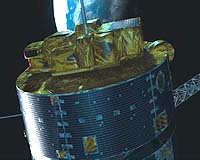
Greenbelt MD (SPX) Mar 07, 2008 Imagine living on a planet where Northern Lights fill the heavens at all hours of the day. Around the clock, even in broad daylight, luminous curtains shimmer and ripple across the sky, mesmerizing anyone who bothers to look. News flash: Astronomers have discovered such a planet. Its name is Earth. "Our own planet has auroras 24 hours a day," says Jim Spann of the Marshall Space Flight Center, "and we can see them even in broad daylight." The trick, he explains, is picking the right wavelength. "If we look at Earth from space using an ultraviolet (UV) filter, we see there are auroras underway at all times. It is a beautiful sight." The extent of the phenomenon was revealed twelve years ago by NASA's Polar satellite. As its name suggests, Polar orbits over Earth's poles, slowly arcing as high as 57,000 km above the arctic where it can take a good long look at the auroras below. Polar is equipped with special UV filters that allow it to photograph auroras through the glare of sunlight and "we were amazed to see Northern and Southern Lights active non-stop," says Spann, one of the scientists who led development of the satellite's UV instrumentation. As an example he offers this movie of a June 2007 auroral display over Antarctica. Just before the video, a solar wind gust buffeted Earth's magnetic field causing a mild geomagnetic storm. Visible light auroras-the kind we see with the human eye--were weak, but "Polar's UV camera picked up a magnificent outburst," says Spann. Watch the movie again; it highlights an ancient mystery. Long ago, arctic sky watchers noticed that mild auroras-the ho-hum kind they saw almost every night--would sometimes erupt without warning in a stunning riot of light and color. 20th-century scientists called these events, with some understatement, "substorms." A good substorm can unleash a hundred thousand billion (1014) Joules of energy, as much as a magnitude 5 earthquake. Although auroras, generally speaking, are understood (they are caused by solar activity), the sudden power of substorms is one of the biggest mysteries of space science. The June 2007 outburst is a classic substorm. "We see plenty of them at UV wavelengths," says Spann. "Polar's ability to monitor both night and day allows us to catch substorms that other satellites might miss." This ability is being put to good use. Polar is now assisting THEMIS, a fleet of five spacecraft launched by NASA in Feb. 2007 to solve the mystery of the substorm. What triggers the events? Where does their power come from? These are some of the questions THEMIS has set out to answer. The five THEMIS satellites are equipped with sensors to map the complex ebb and flow of particles and fields in Earth's magnetosphere. (The magnetosphere is a vast magnetic bubble around Earth. It is the "force field" that protects us from solar wind, and which lights up with auroras when solar wind gusts come crashing into it.) While a single spacecraft might be confused by the magnetosphere's suddenly shifting electrodynamics, the THEMIS quintet, working together, is able make sense out of very complicated events. Researchers hope this will lead to an understanding of the substorm phenomenon. Polar is valuable because no other spacecraft can match its global view of the auroras. "We provide the big picture while THEMIS sorts out the crucial details." At an age of 12 years, Polar is well past its design lifetime. "It's amazing that we're still in business," notes Spann. Moreover, by joining THEMIS, the veteran spacecraft is on the verge of new discovery. Even for Polar, however, the auroras must stop sometime. During the writing of this story, the spacecraft ran out of fuel, limiting its ability to track Earth's poles. Nevertheless, mission planners believe they can squeeze another one or two month's worth of observing out of Polar in support of THEMIS. Its final images may be key pieces to the auroral puzzle. Farewell, Polar--and thanks for all the substorms! Community Email This Article Comment On This Article Related Links Mystery of Auroras Solar Science News at SpaceDaily
 Spring Is Aurora Season
 Los Angeles CA (SPX) Mar 06, 2008
What are the signs of spring? They are as familiar as a blooming daffodil, a songbird at dawn, a surprising shaft of warmth from the afternoon sun. And, oh yes, don't forget the aurora borealis. Spring is aurora season. For reasons not fully understood by scientists, the weeks around the vernal equinox are prone to Northern Lights. |
|
|

| The content herein, unless otherwise known to be public domain, are Copyright 1995-2007 - SpaceDaily.AFP and UPI Wire Stories are copyright Agence France-Presse and United Press International. ESA Portal Reports are copyright European Space Agency. All NASA sourced material is public domain. Additional copyrights may apply in whole or part to other bona fide parties. Advertising does not imply endorsement,agreement or approval of any opinions, statements or information provided by SpaceDaily on any Web page published or hosted by SpaceDaily. Privacy Statement |