|
 |
 |
 |
 |
 |
 |
 |
 |

 |
Aurora Borealis Breaks New Grounds - And Old Ice
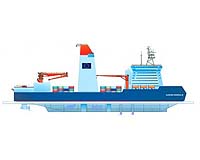
Paris, France (SPX) Dec 03, 2007 It can crush ice sideways and stay precisely on station to an accuracy of a metre. It can drill a hole 1,000 metres deep into the seabed while floating above 5,000 metres of ocean and it can generate 55 megawatts of power. So far, Aurora Borealis is the most unusual ship that has never been built, and it represents a floating laboratory for European science, a breakthrough for polar research and a very big headache for international lawyers. Aurora Borealis will be the first ever international ship, the brainchild of the European Science Federation, the Alfred Wegener Institute for Polar and Maritime Research in Germany and the Germany Federal Ministry of Research and Education. Russia has announced that it will be a partner in launching this state-of-the-art research vessel, but other European nations may soon join the project. But a European ship represents a metaphorical voyage into unknown waters, the ESF Science Policy Conference learned. "We do not have a European flag at the moment so one nation has to be responsible. And if it is internationally owned, you can imagine the difficulty," said Nicole Biebow, manager of the project, and a scientist at the Alfred Wegener Institute. "We have to agree where this ship should have its home port. And what happens if there is an accident? Who is responsible if you have an oil spill on the ice, for instance?" The ice over the polar seas masks millions of years of the planet's history: drilling is difficult in freezing conditions. Aurora Borealis will be the world's first icebreaker that is also a drilling ship. This sets unusual challenges for marine engineers: a vessel poised on top of 5000 metres of drilling rig cannot afford to move very much in any direction. But ice drifts, and currents and winds can alter in moments. So the ship will be designed not just to break the ice as it moves forward and astern, but also to port and starboard. "We had some early ice tanks tests and they came up with a design that is able to break ice sideways," said Paul Egerton, head of the European Polar Board within the European Science Federation. "As the ice continually presses against the side of the ship, the pieces of ice go underneath the hull and are washed away by the propulsion system. There is also a kind of damping system so the ship can raise itself up and down vertically to break the ice. It has a propeller that can turn 360 degrees, linked to satellite navigation. A lot of the cruise ships now have this so they can navigate in a very small area. But the propeller also has to break ice: it has to be strengthened." Not only will the diesel-electric ship be the floating equivalent of a 55 megawatt power station, it will be an intellectual powerhouse as well. It will be probe the role of polar waters in global climate change. Drill cores from the sea floor could answer questions about the geological history of the Arctic ocean, and other instruments will measure the transport of contaminants through the air, water and ice. The vessel could be home to 120 people, more than half of them scientists who need to go to sea to study the ice, the ocean beneath and the history of the deep sea floor. It will be equipped with two "moon pools" in the bottom of the hull to give direct access to the open water beneath the ice, so that drillers can work in freezing conditions and biologists can launch underwater vehicles to study the mysterious processes that trigger an explosion of life in the polar seas every spring. The design and preparation of Aurora Borealis will continue until 2011. Builders could start assembling the hull in 2012, it could be cruising the oceans from 2014 - and it could begin answering some of the great questions of ocean science for the next 40 years. Community Email This Article Comment On This Article Related Links European Science Federation Beyond the Ice Age
 Interest in sub-glacial waters global
 College Station, Texas (UPI) Nov 21, 2007
 The study of Antarctica's sub-glacial environment will be the next focus for polar research, predicts a Texas A&M professor who led several Antarctica studies. |
|
|

| The content herein, unless otherwise known to be public domain, are Copyright 1995-2007 - SpaceDaily.AFP and UPI Wire Stories are copyright Agence France-Presse and United Press International. ESA Portal Reports are copyright European Space Agency. All NASA sourced material is public domain. Additional copyrights may apply in whole or part to other bona fide parties. Advertising does not imply endorsement,agreement or approval of any opinions, statements or information provided by SpaceDaily on any Web page published or hosted by SpaceDaily. Privacy Statement |