|
 |
 |
 |
 |
 |
 |
 |
 |

 |
Aura Around Earth
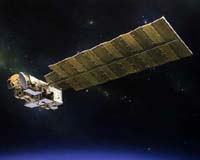
Moffett Field CA (SPX) Jul 16, 2004 The AURA satellite was launched successfully into orbit early Thursday, on its mission to study the Earth's atmosphere, climate change and regional differences in air quality, NASA said. After four technical delays and a month-long wait from its original launch date in mid-June, a towering Boeing Delta II rocket blasted from Vandenberg Air Force Base in California, lifting the 2,967-kilogram (6,542-pound) satellite into the night sky at 3:02 am (1002 GMT). Less than half-an-hour later, the rocket separated from the satellite and the second-stage rocket ignited to take AURA to its orbit path at 704 kilometers (438 miles) altitude.
Mission To Planet Earth Continues... "The atmosphere is one of the most important and limited resources that we have," says Phil DeCola, Aura program scientist at NASA Headquarters in Washington D.C. "The kind of global coverage that we're going to get on almost a daily basis from all these instruments (on Aura) is unprecedented." Aura has four instruments to measure ozone and trace atmospheric gases: the Microwave Limb Sounder (MLS), the High Resolution Dynamics Limb Sounder (HIRDLS), the Tropospheric Emission Spectrometer (TES), and the Ozone Monitoring Instrument (OMI). These instruments will track climate change, and also monitor the ozone layer. The "ozone hole" is actually a thinning of the ozone layer over Antarctica. Pollutants such as Chlorofluorocarbons (CFCs) deplete the ozone layer, although international agreements like the Montreal Protocol have banned such chemicals. Aura will determine if the treaties are effective by detecting global levels of CFCs and their byproducts, chlorine and bromine, that destroy the ozone layer. Aura also will track regional and global air quality, detecting gases that create smog and ozone. When ozone exists in the lower atmosphere, the troposphere, it acts as an air pollutant. "We live in one atmosphere," says Mark Schoeberl, Aura project scientist at NASA's Goddard Space Flight Center in Maryland. "That one atmosphere contains pollutants which are pushed into the atmosphere by industrialized nations, by biomass burning in the tropics, by agricultural activity. Those pollutants float downstream, and you and I are breathing someone else's exhaust gases." Aura will work in cooperation with other satellites, which will all fly in formation to get a more comprehensive view of the planet. Dubbed the "A-train," the Aqua satellite, which monitors water quality, will lead the pack. Aqua will be followed by Calypso, due to be launched next year. Cloudsat and the French satellite Parasol will follow Calypso, and Aura will head up the rear. Schoeberl says that using the new technologies of Aura to study the Earth could lead to technologies that will study other planetary atmospheres. Earth is the only planet that we know of that has life, and Aura could help us better understand the close relationship life has with a planetary atmosphere. Life on Earth is not only dependent on the planet's atmosphere, it interacts with it and can even change it over time. "Bacteria started probably 2 billion years ago making oxygen in an atmosphere that had none. We're altering it even further," says Schoeberl. "So in the exploration of the universe, developing the technologies and precise instruments to look at the atmosphere is going to help. (Aura) is a technological stepping stone for the exploration of the solar system."
Community Email This Article Comment On This Article Related Links Aura at GSFC SpaceDaily Search SpaceDaily Subscribe To SpaceDaily Express Earth Observation News - Suppiliers, Technology and Application
 New Legislation Initiated To Support Commercial Remote Sensing Industry
 New York NY (SPX) Jan 11, 2006
The importance of remotely sensed data and technologies to support natural disasters has prompted attention and action in Washington. New initiatives and legislation authorizing appropriations to the remote sensing industry will be discussed at Strategic Research Institute's U.S. Commercial Remote Sensing Industry conference, scheduled for February 9-10, 2006 in Washington D.C. |
|
|

| The content herein, unless otherwise known to be public domain, are Copyright 1995-2006 - SpaceDaily.AFP and UPI Wire Stories are copyright Agence France-Presse and United Press International. ESA PortalReports are copyright European Space Agency. All NASA sourced material is public domain. Additionalcopyrights may apply in whole or part to other bona fide parties. Advertising does not imply endorsement,agreement or approval of any opinions, statements or information provided by SpaceDaily on any Web page published or hosted by SpaceDaily. Privacy Statement |