|
 |
 |
 |
 |
 |
 |
 |
 |

 |
Atlas Found!
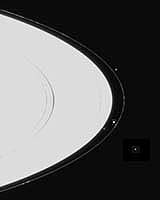
Pasadena (SPX) Jul 01, 2004 The Cassini spacecraft has sighted the tiny moon Atlas, which is seen here for the first time since Voyager 1 flew past Saturn in 1980. Cassini's narrow angle camera captured a sequence of 112 images in visible light, which were used to create a movie of Atlas and other moons racing around the outer edge of Saturn's rings. One of those images is shown here. Over the course of almost five and one-quarter hours, Cassini watched the moons as they circled the planet, snapping 1.2-second exposures about 12 minutes apart. These images were part of a sequence designed specifically to search for small moons near Saturn's F ring. Contrast was enhanced in the images, and the rings themselves were overexposed intentionally, to make these small moons visible. A group of three moons can be seen rounding the right loop of Saturn's rings, followed by a fourth moon. In the first group, the moon exterior to Saturn's thin, knotted F ring is Epimetheus (116 kilometers, 72 miles across); the two moons interior to the F ring are Prometheus (102 kilometers, 63 miles across) and tiny unresolved Atlas (32 kilometers, 20 miles across). The fourth moon seen here, exterior to the F ring and tagging along behind the others, is Pandora (84 kilometers, 52 miles across). At the same time, on the left side, Janus can be seen (181 kilometers, 113 miles across). The view is taken looking upward from Cassini's southern vantage point beneath the ring plane. The moons visible here are orbiting Saturn in a plane that is tilted 67 degrees away from the viewer. These images were taken on May 26 and 27, 2004, from a distance of approximately 19.2 million kilometers (11.9 million miles) from Saturn. The image scale is approximately 114 kilometers (71 miles) per pixel. Community Email This Article Comment On This Article Related Links Cassini at JPL Cassini Image Team SpaceDaily Search SpaceDaily Subscribe To SpaceDaily Express Explore The Ring World of Saturn and her moons Jupiter and its Moons The million outer planets of a star called Sol News Flash at Mercury
 Cassini Images Halo Around Titanic Moon Off Saturn
 Pasadena CA (SPX) Dec 27, 2005
With its thick, distended atmosphere, Titan's orange globe shines softly, encircled by a thin halo of purple light-scattering haze. |
|
|

| The content herein, unless otherwise known to be public domain, are Copyright 1995-2006 - SpaceDaily.AFP and UPI Wire Stories are copyright Agence France-Presse and United Press International. ESA PortalReports are copyright European Space Agency. All NASA sourced material is public domain. Additionalcopyrights may apply in whole or part to other bona fide parties. Advertising does not imply endorsement,agreement or approval of any opinions, statements or information provided by SpaceDaily on any Web page published or hosted by SpaceDaily. Privacy Statement |