|
 |
 |
 |
 |
 |
 |
 |
 |

 |
Atlantis Astronauts Set For Major Space Station Work
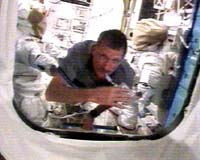
Houston (AFP) Sept 11, 2006 In a delicate robotic handoff, astronauts pulled two solar panels from shuttle Atlantis' cargo bay Monday and delivered them to the International Space Station for the first assembly work in nearly four years. The three ISS residents warmly greeted the Atlantis crew after the shuttle docked with the space station, and the astronauts quickly went to work to prepare to install the solar panels that will provide a quarter of the ISS's power once it is finished. After shaking hands and taking pictures, the astronauts used the shuttle's robotic arm to hand a 16-tonne truss segment with the solar arrays to the station's own Canadian-made arm. The segment will be attached to the station Tuesday. The last ISS assembly mission was in November 2002, as the Columbia disaster three months later forced the National Aeronautics and Space Administration to focus on improving shuttle flight safety. After two Discovery shuttle missions aimed at making space flight safer, NASA said it was ready to resume construction of the half-finished orbiting laboratory. The 11-day Atlantis mission, which launched Saturday, has been billed as the most complex station assembly work to date. After the segment is attached to the station Tuesday, Atlantis mission specialists Joe Tanner and Heidemarie Stefanyshyn-Piper will venture out on a spacewalk to connect power cables. Two other spacewalks are planned to install the solar panels this week. US space officials were pleased with how the mission has gone so far -- particularly Monday's picture-perfect docking of the Atlantis with the ISS. "It was very spectacular stuff today," said Paul Dye, NASA's lead flight director for the mission. "The rendezvous this morning was probably just about as perfect as a rendezvous I have ever been part of." On its way to the ISS, Atlantis' heat shield went through a thorough examination in what has become a routine safety check since the Columbia accident that killed seven astronauts. Before docking, Commander Brent Jett steered the orbiter into a backflip 200 meters (yards) below the ISS to allow the station crew to photograph Atlantis' underbelly. On Sunday, the Atlantis astronauts used the orbiter boom sensor system, attached to the end of the shuttle's robotic arm, to closely inspect the wing leading edges and the nose cap for potential damage from debris during the launch. Columbia was doomed by foam insulation that peeled off its external fuel tank during liftoff and pierced its heat shield, causing it to disintegrate as it returned to Earth with seven astronauts aboard in February 2003. The Discovery missions in 2005 and in July focused on boosting safety to set the stage for regular shuttle flights to the space station. NASA plans 15 more shuttle trips to complete the orbiting laboratory by 2010, when the three-shuttle fleet is to be retired. Completing the ISS is central to US ambitions to fly humans back to the Moon and eventually to Mars. The Atlantis crew includes Jett, Stefanyshyn-Piper, Tanner, co-pilot Chris Ferguson and mission specialists Daniel Burbank and Steve MacLean of the Canadian Space Agency. The crew aboard the ISS are Russian Pavel Vinogradov, American Jeffrey Williams and German Thomas Reiter.
Source: Agence France-Presse Community Email This Article Comment On This Article Related Links Space Station News at Space-Travel.Com Space Station News at Space-Travel.Com
 Building A Ship Outside A Shipyard
 Washington DC (SPX) Sep 11, 2006
It's not your typical shipbuilder's site. In fact, it's not your typical ship. There are no outfitting piers or full-service bulkheads. No sights of yellow hard hats or sounds of beeping trucks with back-up alarms. However, men and women are at work, harder now than ever before. |
|
|

| The content herein, unless otherwise known to be public domain, are Copyright 1995-2006 - SpaceDaily.AFP and UPI Wire Stories are copyright Agence France-Presse and United Press International. ESA PortalReports are copyright European Space Agency. All NASA sourced material is public domain. Additionalcopyrights may apply in whole or part to other bona fide parties. Advertising does not imply endorsement,agreement or approval of any opinions, statements or information provided by SpaceDaily on any Web page published or hosted by SpaceDaily. Privacy Statement |