
 |
 |
 |
 |
 |
 |
 |
 |
 |

 |
Astronomy Without Borders On Show In China
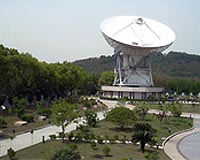
Canberra, Australia (SPX) Jun 19, 2008 Working from China, CSIRO astronomers have remotely controlled telescopes in three countries and streamed their data to CSIRO's Parkes Observatory in New South Wales for processing in real time. "We're now in the age of astronomy without borders," said Dr Tasso Tzioumis of CSIRO's Australia Telescope National Facility (ATNF). "From a single operations centre we can make huge streams of precisely time-linked data flow simultaneously between several countries, at gigabits per second." The demonstration was made yesterday (Tuesday 17 June) at Shanghai Observatory during the 7th annual international meeting on "e-VLBI" or electronic very long baseline interferometry. E-VLBI is the technique of simultaneously using telescopes hundreds or thousands of kilometres apart to form a single coordinated system. Dr Tzioumis, Dr Chris Phillips and Dr Shaun Amy, all from CSIRO's Australia Telescope National Facility, worked with their Chinese and Japanese colleagues to control the 25-m radio telescope of the Shanghai Astronomical Observatory, the 34-m telescope of the National Institute of Information and Communications Technology (NICT) in Kashima, Japan, and the CSIRO radio telescopes near Parkes, Coonabarabran and Narrabri in New South Wales. The target objects for the demonstration were mainly black holes in distant galaxies. "The demonstration establishes two things," said Dr Chris Phillips. "First, we've shown Australia can be the data-processing centre for these international experiments. Previously, we'd had the data going out of Australia rather than into it." "Second, we've proved that the Australian, Chinese and Japanese systems, which grew up independently, are compatible. That's important for doing future experiments together in the Asia-Pacific region." The telescope data were streamed to a supercomputer cluster at the Parkes Observatory owned by Swinburne University, and processed using software written by Swinburne PhD student Adam Deller. The results were then streamed back to the observers in Shanghai. Each telescope required 512 megabytes per second of bandwidth. Data links were provided by AARNet (Australia's National Research and Education Network) and its counterparts CSTNet in China, JGN2plus in Japan, and CENIC and Pacific Wave in the USA. Chris Hancock, CEO of AARNet said, "This is the first time Australia has collaborated directly with research institutions in Asia and AARNet is proud to have enabled this collaborative program between Australian and Asian researchers." To support this experiment AARNet provided dedicated lightpaths that allowed the participating telescopes to be connected directly to the supercomputer cluster processing the data. "Dedicated lightpaths are essential for this kind of experiment, because they eliminate network congestion and have very low latency," said Dr Shaun Amy. Astronomers use e-VLBI mainly to study objects that are small or very distant (such as nearby double-star systems or black holes in the distant universe) and transient events (such as supernovae, flares on stars, and gamma-ray bursts). For the demonstration from China the telescopes were targeting mainly "active galactic nuclei" - supermassive black holes at the heart of distant galaxies. Material being dragged into a black hole produces strong radio emission that is easily detected using e-VLBI. Hence, these black-hole systems are perfect for testing an e-VLBI system. Advances in international connectivity are opening up huge opportunities for e-VLBI. The demonstration from China follows successful e-VLBI tests between Australia and Europe in September 2007, in which data from several telescopes was combined and processed in Europe. Those tests took place under the European EXPReS (Express Production and Real-time e-VLBI Service) project. In April this year CSIRO was awarded a 10 gigabits per second link across the USA for a year by the Internet2 consortium, which represents more than 300 US companies and institutions. Using the link, CSIRO will work with its international collaborators to extend and refine the technique of e-VLBI. Community Email This Article Comment On This Article Share This Article With Planet Earth
Related Links Astronomy News from Skynightly.com
 Austria Declares Intent To Join ESO
 Vienna, Austria (SPX) Apr 28, 2008
At a press conference today at the University of Vienna's Observatory, the Austrian Science Minister Johannes Hahn announced the decision by the Austrian Government to seek membership of ESO from 1 July this year. |
|
|

| The content herein, unless otherwise known to be public domain, are Copyright 1995-2007 - SpaceDaily.AFP and UPI Wire Stories are copyright Agence France-Presse and United Press International. ESA Portal Reports are copyright European Space Agency. All NASA sourced material is public domain. Additional copyrights may apply in whole or part to other bona fide parties. Advertising does not imply endorsement,agreement or approval of any opinions, statements or information provided by SpaceDaily on any Web page published or hosted by SpaceDaily. Privacy Statement |
 del.icio.us
 Digg
Digg Reddit
 YahooMyWeb
 Google
 Facebook