
 |
 |
 |
 |
 |
 |
 |
 |
 |

 |
Astronomers discover clutch of 'super-Earths'
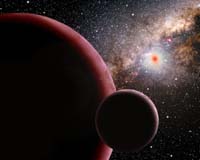
Nantes, France (AFP) June 16, 2008 European scientists on Monday said they had located five 'super-Earths', each of them four-to-30 times bigger than our planet, in a trio of distant solar systems. The discovery suggests that at least one third of stars similar to our own Sun host these difficult-to-detect celestial bodies, multiplying previous estimates by five. It also brings astronomers closer to finding planets outside our solar system, called exoplanets, that could potentially duplicate the conditions that gave rise to life on Earth. "In a year or two, it is likely that we will find habitable planets circling small stars" such as the Sun, said Setphane Udry, a researcher at Switzerland's Geneva Observatory and a member of the team that made the discovery. Three of the five 'super-Earths' -- so-called because they are several times the mass of our own planet -- orbit a star known as HD 40307 some 42 lights away, the scientists reported. One light-year is roughly equivalent to 9.5 trillion kilometres (6 trillion miles). They have 4.2, 6.7, and 9.4 times the mass of the Earth, and orbit their sun in periods of 4.3, 9.6, and 20.4 days, respectively. The rapid orbits make the super-Earths easier to detect -- but it also means that they are probably gaseous balls of fire inhospitable to life as we know it. The first exoplanet was detected in 1995, and less than 280 had been catalogued before today's findings, unveiled at an astronomy conference in Nantes, France. But a new generation of powerful instruments is almost certain to expand the list rapidly, say scientists. The recent batch of exoplanets were all spotted with the High-Accuracy Radial-Velocity Planet Searcher (HARPS), a 3.6-metre telescope and spectograph perched atop La Scilla mountain at the southern edge of Chile's Atacama Desert. HARPS, sometimes called the "planet hunter", has uncovered 45 super-Earths since it began operation in 2004. "Clearly these planets are only the tip of the iceberg," says Mayor. "The analysis of all the stars studied with HARPS shows that about one third of solar-like stars have either super-Earth or Neptune-like planets with orbital periods shorter than 50 days." Earth orbits the Sun once every 365 days. Distant planets, even big ones, are too small to be directly observed, and can only be detected by measuring their impact on the movement of the stars they orbit. "The mass of the smallest planets is 100,000 times smaller than that of the star, and only the high sensitivity of HARPS made it possible to detect them," says co-author Francois Bouchy, from the Astrophysics Institute of Paris. All of the exoplanets unveiled Monday have masses four to 30 times greater than Earth's, and orbits at least seven times shorter. The further from the star, the harder they are to observe. At the same conference, astronomers announced the discovery of two other planetary systems, also with the HARPS spectrograph. In one, a super-Earth orbits the star HD 181433 every 9.5 days. The same star also hosts a huge, Jupiter-like planet that circles every three years. The second system contains a fiery planet 22 times the size of Earth that circumnavigates its sun every four days, and a Saturn-like sphere with a three-year orbit. "It is probable that there are many other planets present -- not only super-Earths, but Earth like-planets that we cannot yet detect," said Stephane Udry, also a researcher at the Geneva Observatory. Planets are formed from a disc of gas and dusty debris left over from the creation of a star. Just how long this process takes is still a matter of debate. Earth is believed to be about 4.5 billion years old, and the Sun about 100 million years older. Community Email This Article Comment On This Article Share This Article With Planet Earth
Related Links Lands Beyond Beyond - extra solar planets - news and science Life Beyond Earth
 Vanderbilt Astronomers Getting Into Planet-Finding Game
 Cape Town, South Africa (SPX) Jun 11, 2008
Vanderbilt astronomers have constructed a special-purpose telescope that will allow them to participate in one of the hottest areas in astronomy - the hunt for earthlike planets circling other stars. |
|
|

| The content herein, unless otherwise known to be public domain, are Copyright 1995-2007 - SpaceDaily.AFP and UPI Wire Stories are copyright Agence France-Presse and United Press International. ESA Portal Reports are copyright European Space Agency. All NASA sourced material is public domain. Additional copyrights may apply in whole or part to other bona fide parties. Advertising does not imply endorsement,agreement or approval of any opinions, statements or information provided by SpaceDaily on any Web page published or hosted by SpaceDaily. Privacy Statement |
 del.icio.us
 Digg
Digg Reddit
 YahooMyWeb
 Google
 Facebook