|
 |
 |
 |
 |
 |
 |
 |
 |

 |
Astronomers Will Use Sirtf To Study Star Formation In Nearby Galaxies
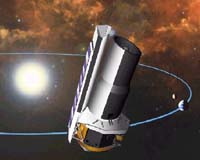
Tucson - Apr 11, 2003 Our Milky Way galaxy will produce about one new star this year. But this year other nearby galaxies will pump out hundreds of new stars. Still other nearby galaxies gave birth to their last star about 10 billion years ago. Astronomers will use all three Space Infrared Telescope Facility (SIRTF) science instruments in nearly all modes to discover why some of our galactic neighbors are prolific or now barren in a SIRTF Legacy Science Program called "SINGS." SIRTF is planned for launch Friday, April 18. "Our program begins in earnest about four months after launch," said University of Arizona astronomy Professor Robert C. Kennicutt Jr. He leads a team of 22 scientists based at the UA Steward Observatory, the Space Telescope Science Institute in Baltimore, Md., Caltech's SIRTF Science Center and six other institutions in the "SIRTF Nearby Galaxy Survey," or SINGS. Five other teams, including one headed by UA astronomer Michael R. Meyer, also were chosen for the SIRTF Legacy Science Program. The six projects comprise more than 3,000 hours of observations, or about half the time available during SIRTF's first year of operation. The fourth and last of NASA's Great Observatories, SIRTF will view the universe at very long wavelengths, the far infrared, and see objects that are too cool, too dust-enshrouded or too far away to otherwise be seen. The three previous Great Observatories are the Hubble Space Telescope, Compton Gamma Ray, and Chandra X-ray Observatories. SIRTF is managed for NASA by the Jet Propulsion Laboratory, Pasadena, Calif. The SIRTF telescope is designed to operate at a temperature of only a few degrees above absolute zero, and it carries three science instruments. One of these is a highly sensitive camera called MIPS that uses the first true imaging arrays at far-infared wavelengths and will see the coolest objects in space. It was built by a team headed by the UA astronomy Professor George H. Rieke. The SINGS team will survey 75 galaxies up to 100 million light years away in the Virgo supercluster of galaxies, the supercluster that contains the Milky Way, to learn more about how stars form from dust and gas. The 75 galaxies include about every nearby kind imaginable. They differ in how much infrared light they emit relative to visible light, by morphology or type, and by as much as 100,000 times in mass. "We chose galaxies to represent the full range of galaxies in the local population," Kennicutt said. "Some are spiral, some elliptical. Some aren't forming many stars at all, others are forming stars 100 times faster than the Milky Way. Some are very dusty and emit most of their light in the infrared, and some have no dust at all. Some are interacting galaxies, some exist by themselves. "We picked as representative a sample of nearby galaxies as possible because part of the goal of all the Legacy Programs is not only to focus on a specific science program, but also to build a library of data that other scientists can build on as well," Kennicutt said. Why nearby galaxies have such different star formation rates is a complicated problem. It�s not simply that star formation is regulated by the amount of gas present in the galaxy. "When a lot of stars form in one place, they tend to disperse the gas and quench star formation," Kennicutt noted. "So the way in which the interstellar medium and young stars interact is more like a complex ecosystem." "The range of light wavelengths to which SIRTF is sensitive allows us to trace every phase of gas that surrounds a star-forming region. It can probe the cold molecular gas from which stars form, the ionized gas lit up by hot stars, and the warm gas in between. Up to now," Kennicutt said, "those processes have only been studied up close in our own Milky Way. We�ll be able to see a wide range of environments in galaxies a thousand times bigger than the Milky Way." One important part of the SINGS project is that it includes a good deal of observing time on ground-based telescopes, he added. The SINGS team won 50 nights of observing time at Kitt Peak and Cerro Tololo telescopes and almost 100 nights on UA Steward Observatory telescopes. In addition, other astronomers have been observing the galaxies on the Very Large Array in Socorro, N.M., and other radio telescopes in Europe and Australia. Collaborating Caltech astronomers intend to observe the sample in the ultraviolet with another satellite, GALEX, that is scheduled for launch later this spring. "By the time our project is completed, this will be the most thoroughly observed set of galaxies ever put together," Kennicutt said. A strictly observational goal is to build the tools astronomers need to more accurately measure how much star formation actually does take place in nearby galaxies. Astronomers can then apply those tools not only to the 75 galaxies in the SINGS sample, but to high redshift galaxies that were observed in the 1990s with the Hubble Space Telescope�s infrared instrument NICMOS, a project headed by UA astronomy Professor Roger Thompson, and that will again be observed with SIRTF. SINGS will also shed light on the nature of starburst galaxies. These nearby objects are extremely active in forming stars and are believed to be analogs of the type of galaxy that was common 15 billion or 10 billion years ago, Kennicutt said. The Hubble Space Telescope revealed very distant young galaxies in the famous Hubble Deep Field images, but the infant galaxies are seen as single blobs of light. Much of what SINGS discovers about nearby baby-boom galaxies can be used to understand the distant infant galaxies, he added. Members of the SINGS team include;; UA Steward Observatory � Kennicutt (principal investigator), George Rieke, Marcia Rieke, George Bendo, Chad Englebracht, Karl Gordon, Aigen Li, J. D. Smith; Bucknell University � Michele Thornley; Caltech � Lee Armus, George Helou, Thomas Jarrett, Helene Roussel; Harvard/Smithsonian Center for Astrophysics � Lisa Kewley; NASA Ames Research Center � David Hollenbach; National Radio Astronomy Observatory � Fabian Walter; Princeton University � Bruce Draine; Space Telescope Science Institute � Daniela Calzetti, Claus Leitherer, Michael Regan, Sangeeta Malhotra; University of Wyoming � Daniel Dale. Community Email This Article Comment On This Article Related Links SpaceDaily Search SpaceDaily Subscribe To SpaceDaily Express Space Telescope News and Technology at Skynightly.com
 Cornell's Contract For Management Of Arecibo Observatory Renewed
 Ithaca NY (SPX) Apr 06, 2005
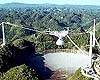
The National Science Foundation (NSF) has renewed Cornell University's management contract for the operation of Arecibo Observatory, the world's largest and most-sensitive single-dish radio/radar telescope. |
|
|

| The content herein, unless otherwise known to be public domain, are Copyright 1995-2006 - SpaceDaily.AFP and UPI Wire Stories are copyright Agence France-Presse and United Press International. ESA PortalReports are copyright European Space Agency. All NASA sourced material is public domain. Additionalcopyrights may apply in whole or part to other bona fide parties. Advertising does not imply endorsement,agreement or approval of any opinions, statements or information provided by SpaceDaily on any Web page published or hosted by SpaceDaily. Privacy Statement |