|
 |
 |
 |
 |
 |
 |
 |
 |

 |
Astronomers Unveil A Lack Of Dark Matter
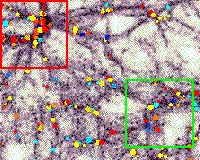
Sydney - Dec 11, 2001 The Universe's mysterious invisible Dark Matter is distributed on large scales in exactly the same way the galaxies are, according to scientists analysing data from the giant 2dF Galaxy Redshift Survey done with the 3.9-m Anglo-Australian Telescope in eastern Australia. The finding means the Universe is surprisingly simple. The Dark Matter could have been clumpier than normal matter, or vice versa. Instead, they're the same. Astronomers believe that slight clumping in the Dark Matter in the very early Universe 'seeded' the growth of galaxies. "This result will place strong constraints on theories of where and how galaxies form," said Dr Alan Heavens of the University of Edinburgh, UK, one of the lead authors on a paper posted today on the online preprint service astro-ph. Galaxies are pulled around by the gravity of the Dark Matter, forming into large-scale 'sheets' and 'filaments'. In their paper Dr Heavens and co-author Dr Licia Verde (Rutgers and Princeton Universities, USA) and their colleagues show that on large scales the sheets and filaments in the galaxy distribution revealed by the 2dF survey are just what is expected if the galaxies and Dark Matter cluster in the same way. "Imagine a mountain range at night, dotted with campfires," said Dr Matthew Colless of the Australian National University, a co-leader of the 2dF Galaxy Redshift Survey team. "You can't see the mountains, only the fires. Where are the mountain peaks? We now know that everywhere you see a fire - a galaxy - it marks the peak of a mountain - a concentration of Dark Matter. One campfire, one peak." The result also confirms previous findings that show there is not enough Dark Matter to stop the Universe expanding forever. "Knowing how clustered the Dark Matter is, also reveals how much of it there is," said Dr Verde - about seven times as much as ordinary matter, but only a quarter of what is needed to halt the expansion of the Universe. In a second study, also posted on astro-ph, Dr Ofer Lahav and Dr Sarah Bridle (both from the Institute of Astronomy, Cambridge University, UK) and their co-authors have compared the fluctuations in the 2dF galaxy distribution with those in the Cosmic Microwave Background (CMB) - radiation left over from the Big Bang. They found remarkable agreement between the distribution of luminous galaxies and the distribution of mass on scales larger than 30 million light-years. This gives independent support to the finding of Verde and Heavens, which is based on an entirely different method. A second important result in both studies is that ripples in the mass distribution are not as strong as previously thought. '"The ripples are about 20 per cent smaller in amplitude, suggesting that the growth of structure in the Universe is more gentle, and for example would produce fewer galaxy clusters," said Ofer Lahav. This result tells astronomers how efficiently gas can turn into observable galaxies such as our own Milky Way. The 2dF (two-degree field) survey has compiled the world's largest database of more than 210 000 galaxies, using the Anglo-Australian telescope in New South Wales, Australia. Designed and built by the Anglo-Australian Observatory, the 2dF instrument is one of the world's most complex astronomical instruments, able to capture 400 spectra simultaneously. A robot arm positions up to 400 optical fibres on a field plate, each to within an accuracy of 20 micrometres. Light from up to 400 objects is collected and fed into two spectrographs for analysis. The expansion of the Universe shifts galaxy spectra to longer wavelengths. By measuring this 'redshift' in a galaxy's spectrum, the galaxy's distance can be determined. The 2dF survey covers a total area of about 2 000 square degrees, selected from both northern and southern skies. 2DF GALAXY REDSHIFT SURVEY TEAM MEMBERS: Anglo-Australian Observatory - Joss Bland-Hawthorn, Terry Bridges, Russell Cannon, Ian Lewis; Australian National University - Matthew Colless, Carole Jackson, Bruce Peterson; California Institute of Technology - Richard Ellis, Keith Taylor; Johns Hopkins University - Ivan Baldry, Karl Glazebrook; Liverpool John Moores University - Chris Collins; University of Cambridge - George Efstathiou, Ofer Lahav, Darren Madgwick; University of Durham - Carlton Baugh, Shaun Cole, Carlos Frenk, Peder Norberg; University of Edinburgh - John Peacock, Will Percival, Will Sutherland; University of Leeds - Stuart Lumsden; University of New South Wales - Warrick Couch, Kathryn Deeley, Roberto de Propris; University of Nottingham - Edward Hawkins, Steve Maddox*; University of Oxford - Gavin Dalton, Mark Seaborne; University of St Andrews - Nicholas Cross, Simon Driver
Email This Article Comment On This Article Related Links Graphics and Papers The 2dF galaxy redshift survey website, including fly-through Anglo-Australian Observatory SpaceDaily Search SpaceDaily Subscribe To SpaceDaily Express Nuclear Space Technology at Space-Travel.com
 JHU-STScI Team Maps Dark Matter In Startling Detail
 Baltimore MD (SPX) Dec 12, 2005
Clues revealed by the recently sharpened view of the Hubble Space Telescope have allowed astronomers to map the location of invisible "dark matter" in unprecedented detail in two very young galaxy clusters.
--------------------------------------------------------- It's new. And it's downright terrific! Celestron's CPC Schmidt-Cassegrain telescope is the scope you've been waiting for! It offers new alignment technology, advanced engineering, and bold new design at a new, low price! In fact, Celestron's Professional Computerized (CPC) scope with revolutionary SkyAlign Alignment Technology redefines everything that amateur astronomers are looking for. It offers quick and simple alignment, GPS technology, unsurpassed optical quality, ease of use, advanced ergonomics, enhanced computerization and, most important, affordability. Want to view M-31 tonight? One button takes you there!
Shop for telescopes online at Telescopes.com! today!
|
|
|

| The content herein, unless otherwise known to be public domain, are Copyright 1995-2006 - SpaceDaily.AFP and UPI Wire Stories are copyright Agence France-Presse and United Press International. ESA PortalReports are copyright European Space Agency. All NASA sourced material is public domain. Additionalcopyrights may apply in whole or part to other bona fide parties. Advertising does not imply endorsement,agreement or approval of any opinions, statements or information provided by SpaceDaily on any Web page published or hosted by SpaceDaily. Privacy Statement |