|
 |
 |
 |
 |
 |
 |
 |
 |

 |
Astronomers Trace The Evolution Of The First Galaxies In The Universe
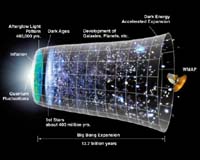
Santa Cruz CA (SPX) Sep 14, 2006 A systematic search for the first bright galaxies to form in the early universe has revealed a dramatic jump in the number of such galaxies around 13 billion years ago. These observations of the earliest stages in the evolution of galaxies provide new evidence for the hierarchical theory of galaxy formation--the idea that large galaxies built up over time as smaller galaxies collided and merged. Astronomers Rychard Bouwens and Garth Illingworth at the University of California, Santa Cruz, used the Hubble Space Telescope to explore the formation of galaxies during the first 900 million years after the Big Bang. They reported their latest findings in the September 14 issue of the journal Nature. Deep observations in three dark patches of sky--the Hubble Ultra Deep Field and the Great Observatories Origins Deep Survey fields--gathered the faint light emitted 13 billion years ago by stars in primeval galaxies. Only the brightest galaxies could be detected at such great distances. "These are the deepest infrared and optical data ever taken. We're looking at a very early stage in the buildup of galaxies," said Illingworth, a professor of astronomy and astrophysics at UCSC. The researchers observed hundreds of bright galaxies at around 900 million years after the Big Bang. But when they looked deeper, about 200 million years earlier in time, they only found one. Relaxing their search criteria a bit turned up a few more candidates, but clearly a lot of changes took place during those 200 million years, Illingworth said. "The bigger, more luminous galaxies just were not in place at 700 million years after the Big Bang. Yet 200 million years later there were many more of them, so there must have been a lot of merging of smaller galaxies during that time," he said. Astronomers can determine when light was emitted from a distant source by its redshift, a measure of how the expansion of the universe stretched the wavelengths of the light as it traveled through space across vast distances. Bouwens, a postdoctoral fellow at UCSC and first author of the Nature paper, developed software to systematically sift through the Hubble data in search of high-redshift galaxies. The data came from two powerful instruments on Hubble, the Advanced Camera for Surveys (ACS) and the Near Infrared Camera and Multi-Object Spectrograph (NICMOS). The researchers compared the numbers of galaxies detected at a redshift of 7 to 8 (700 million years after the Big Bang) with what they might have expected to find if the population of galaxies then were like the population they had observed at redshift 6 (200 million years later). Depending on the strictness of their selection criteria, they found one galaxy where they would have expected 10, or four where they would have expected 17. "Our approach provides a very quantitative way of measuring the buildup of structure in the universe, so we can see how fast it changed over time as smaller galaxies merged to form larger ones," Bouwens said. The galaxies observed in this survey are much smaller than our own Milky Way and other giant galaxies seen today in the nearby universe. These early galaxies were also ablaze with star formation, emitting bluish light that was shifted to red light during its 13-billion-year journey to Hubble's sensitive detectors. "It's quite amazing that we are able to look back across 13 billion years of time. We're looking at galaxies that have already evolved from smaller precursors, but it's only a few hundred million years after the formation of the first stars," Illingworth said. If the Milky Way is a galactic senior citizen, then these galaxies are toddlers or preschoolers. For now, researchers are unable to detect the even smaller infant galaxies that must have merged to form these first bright galaxies. But the seeds of those first galaxies can be seen in the the cosmic microwave background radiation, measured most recently and accurately by the Wilkinson Microwave Anisotropy Probe (WMAP), which shows slight fluctuations of density in a remarkably homogeneous universe about 400,000 years after the Big Bang. "Very early in the evolution of the universe, everything was very smooth. But over time the universe became more and more clumpy as gravity pulled more matter into the denser areas," Bouwens said. "Our observations of early galaxies allow us to measure how fast the universe was evolving from smaller to larger clumps." Detection of the very first galaxies to form will be possible with the successor to Hubble, the James Webb Space Telescope, currently planned for launch in 2013, Illingworth said. Additional information about the search for the first Community Email This Article Comment On This Article Related Links First Galaxies Stellar Chemistry, The Universe And All Within It
 Scientists Detect New Kind Of Cosmic Explosion
 Greenbelt MD (SPX) Sep 01, 2006
Scientists using NASA's Swift satellite have detected a new kind of cosmic explosion. The event appears to be a precursor to a supernova, which is expected to reach peak brightness in one week. |
|
|

| The content herein, unless otherwise known to be public domain, are Copyright 1995-2006 - SpaceDaily.AFP and UPI Wire Stories are copyright Agence France-Presse and United Press International. ESA PortalReports are copyright European Space Agency. All NASA sourced material is public domain. Additionalcopyrights may apply in whole or part to other bona fide parties. Advertising does not imply endorsement,agreement or approval of any opinions, statements or information provided by SpaceDaily on any Web page published or hosted by SpaceDaily. Privacy Statement |