|
 |
 |
 |
 |
 |
 |
 |
 |

 |
Astronomers Take Revealing Peek At Star Factory
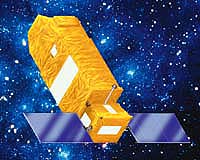
Baltimore MD (SPX) Jan 17, 2005 Using NASA's orbiting Far Ultraviolet Spectroscopic Explorer, a team of astronomers from The Johns Hopkins University and elsewhere has taken an unprecedented peek beneath the "skirts" of the tunic-clad Orion the Hunter and come away with observations that may lead to enhanced knowledge of how interstellar dust absorbs and scatters ultraviolet starlight. "Understanding interstellar dust is important. After all, this is the stuff out of which, ultimately, planets, stars and even people are made," said team member Richard Conn Henry, a professor in the Henry A. Rowland Department of Physics and Astronomy at Johns Hopkins. Henry presented findings during the American Astronomical Society's meeting this week in San Diego. The constellation Orion, named for its resemblance to a powerful, tunic-clad hunter wielding a club and sword, is probably the greatest star factory in our galaxy, with thousands of young, hot, blue stars emerging from its great clouds of gas and dust. Led by Jayant Murthy of the Indian Institute of Astrophysics, the team examined data FUSE recorded near the most active region of current star formation.
What they saw surprised them. "FUSE detected a spectrum of ultraviolet light in a region where there is no star at all," said Murthy, who spent many years at Johns Hopkins before going to the Indian Institute. "The spectrum is of light reflecting from the dust in a region near a quite bright star, whose spectrum is very similar to that of the reflected light we detected. At first, we thought that particular star was the original source of the light." "But a closer look revealed that, despite the similarity, there were differences - differences striking enough to allow us to conclude that the star in question could not be the source of the light that is scattering from the dust. So where was that light coming from?" Team members suspect that the light in question emanated from the Trapezium, a cluster of stars located in the heart of the Orion Nebula. So named because the configuration of its stars resembles a geometric quadrilateral with two parallel sides, the Trapezium not only is one of the most famous multiple star systems in the night sky, but is also - at only about 1 million years old - the youngest. "The ultimate aim of this work is to understand exactly in what manner the light gets reflected: What is this interstellar dust from which the stars are born?" asks David Sahnow, a research scientist in the Department of Physics and Astronomy at Johns Hopkins and a member of the investigating team. "To what extent does the dust absorb the light, and to what extent does it scatter it? For that light which is scattered, does it go backward, forward, or sideways?" Perhaps one of the most interesting aspects of this investigation into interstellar dust is that it happened serendipitously. "This is a great example of how science works sometimes, how you can stumble across something valuable while looking for something else," said Murthy. "We were actually taking engineering tests at some semi-random places in the sky while FUSE was thermalizing, and we noticed this. Our discovery that FUSE's high spectral resolution can actually be applied to diffuse radiation has additional ramifications." "High spectral resolution is often a key to physical understanding, and our Orion observation shows that we will be able to use this technique to more deeply understand the general diffuse background radiation over the sky." NASA funded this research. The team hopes the agency will underwrite further investigations. "We have submitted a proposal to NASA to use FUSE over the next year to explore the ramifications of our surprise discovery that FUSE can detect diffuse emission," Henry said. "By choosing targets carefully, we can get more easily interpreted data, allowing stronger conclusions regarding the nature of interstellar dust. The observed cosmic background is not fully understood and possibly is of new cosmological importance. We are confident that with FUSE and carefully implemented further observations, we can answer many questions for the first time." The team's paper on its observations of Orion has been accepted for publication by the Astrophysical Journal. Designed and operated by a team of engineers and scientists at Johns Hopkins, FUSE is the largest astrophysics mission NASA has ever handed off to a university to manage. The 18-foot tall, 3,000 pound satellite has operated for five years from its perch 475 miles above the Earth's surface, gathering unique data about everything from planets and nearby stars to galaxies and quasars billions of light years away. Community Email This Article Comment On This Article Related Links FUSE at John Hopkins University SpaceDaily Search SpaceDaily Subscribe To SpaceDaily Express Nuclear Space Technology at Space-Travel.com
 The Circadian Clock: Understanding Nature's Timepiece
 Calgary AB (SPX) Mar 08, 2005
A cluster of brain cells less than half the size of a pencil eraser tells you when to wake up, when to be hungry and when it's time to go to sleep. The same cells also cause you to be disoriented after you've flown across multiple time zones. |
|
|

| The content herein, unless otherwise known to be public domain, are Copyright 1995-2006 - SpaceDaily.AFP and UPI Wire Stories are copyright Agence France-Presse and United Press International. ESA PortalReports are copyright European Space Agency. All NASA sourced material is public domain. Additionalcopyrights may apply in whole or part to other bona fide parties. Advertising does not imply endorsement,agreement or approval of any opinions, statements or information provided by SpaceDaily on any Web page published or hosted by SpaceDaily. Privacy Statement |