|
 |
 |
 |
 |
 |
 |
 |
 |

 |
Astronomers See Future Supernova Developing
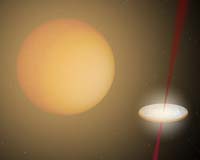
Charlottesville VA (SPX) Jul 25, 2006 Astronomers have found that a nearby two-star system contains a precursor to a Type Ia supernova, an important class of star explosions used to measure the expansion rate of the universe. The observations could help astronomers understand how Type Ia supernovae work. Using ground-based telescopes and NASA satellites, independent teams documented a rare and violent outburst from this system, called RS Ophiuchi, in February 2006. RS Ophiuchi contains white dwarf and a red giant. This is a surprise arrangement for a future Type Ia, and the finding may have broad implications for the supernova field. The teams may have imaged for first time the components of such a binary and have found new details of how a red giant feeds matter onto a white dwarf, the star that will ultimately explode. Results from the Very Long Baseline Array radio observatory and NASA's Rossi X-ray Timing Explorer appeared in the July 20 issue of Nature. Results from the ground-based Infrared Optical Telescope Array (IOTA) will appear in the Astrophysical Journal. Results from other X-ray and infrared telescopes are forthcoming. "One day RS Ophiuchi will explode," said Koji Mukai of NASA Goddard Space Flight Center in Greenbelt, Md., a co-author on the Nature report. "What happened this February is just a little hiccup, but it allowed us to weigh the star and showed us that it's almost heavy enough to go off as a Type Ia supernova," Mukai said. "Only the tiniest fraction of white dwarfs become Type Ia." RS Ophiuchi, in the constellation Ophiuchi, is called a recurrent nova because the system has erupted in 1898, 1933, 1958, 1967, 1985, and 2006. For a few days in mid-February, RS Ophiuchi was visible to the naked eye. Scientists had thought that RS Ophiuchi contains a red giant and a white dwarf. A red giant is a star similar to the Sun nearing the end of its life cycle. Likewise, a white dwarf is a star like the Sun that has run out of hydrogen fuel and whose outer layers have floated away, leaving a dense core about the size of the Earth. Gas from the bloated red giant spills onto the white dwarf, builds up on its surface, and from time to time will ignite in a thermonuclear blast. This happened in RS Ophiuchi in early February. When the white dwarf accumulates enough mass, about 1.4 solar masses, it will obliterate itself. This catastrophic event is a Type Ia supernova. Because a precise amount of mass is involved, every Type Ia supernova in the universe shines at a unified, known luminosity. As a result, Type Ia supernovae are used as mileage posts across the universe. The apparent brightness, as opposed to its absolute brightness, is a direct measure of distance. "There's plenty of theoretical work on novae and supernovae, but precise and simultaneous multi-wavelength observations have been lacking until now," said Richard Barry of NASA Goddard, co-author on the Astrophysical Journal article. With the Rossi X-ray Timing Explorer the scientists measured the mass of the white dwarf to be close to 1.4 solar masses. The star probably still needs hundreds of thousands of years, though, to accumulate the final bit of mass before going supernova. Barry and his colleagues, including John Monnier, University of Michigan, Ann Arbor, said they might have resolved two objects in RS Ophiuchi with IOTA's the sharp "interferometer" eye. This, along with X-ray data, would confirm the assumption that Type Ia supernovae are born in binaries. Infrared data also indicate that the white dwarf might transform itself into red giant for a few days during the outburst. The X-ray observation revealed material flung from the white dwarf colliding with the red giant's solar wind, providing new details of the interaction between the two stars. The VLBA was used to image the expanding shock wave. Type Ia supernovae typically have little hydrogen in their ejected gas, so the presence of a hydrogen-rich red giant in a pre-Type Ia environment is surprising. RS Ophiuchi demonstrates that more than one kind of binary could be the source of Type Ia supernovae. "By studying RS Ophiuchi in many wavelengths, we hope to begin to understand what causes variations among the supposedly standard candles," said Jennifer Sokoloski of Harvard-Smithsonian Center for Astrophysics in Cambridge, Mass., lead author on the Nature report. "This will give us better confidence is measuring distances in the universe, one of the most important topics in cosmology," Sokoloski added. The VLBA is an instrument of the National Radio Astronomy Observatory. IOTA, managed by the Harvard-Smithsonian, is part of the Whipple Observatory on Mt. Wilson in Arizona. The Rossi X-ray Timing Explorer is managed by NASA Goddard. Community Email This Article Comment On This Article Related Links VLBA Stellar Chemistry, The Universe And All Within It
 Planet-Forming Disks Might Put Brakes On Stars
 Pasadena CA (SPX) Jul 25, 2006
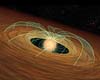
Astronomers using NASA's Spitzer Space Telescope have found evidence that dusty disks of planet-forming material tug on and slow down the young, whirling stars they surround. |
|
|

| The content herein, unless otherwise known to be public domain, are Copyright 1995-2006 - SpaceDaily.AFP and UPI Wire Stories are copyright Agence France-Presse and United Press International. ESA PortalReports are copyright European Space Agency. All NASA sourced material is public domain. Additionalcopyrights may apply in whole or part to other bona fide parties. Advertising does not imply endorsement,agreement or approval of any opinions, statements or information provided by SpaceDaily on any Web page published or hosted by SpaceDaily. Privacy Statement |