|
 |
 |
 |
 |
 |
 |
 |
 |

 |
Astronomers' Holiday Special - A July 4 Comet Bash
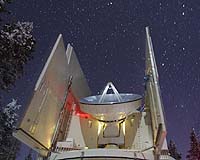
Tucson AZ (SPX) Jun 27, 2005 If you're a ground-based astronomer in Arizona and states west through Hawaii, you'll wish for clear, dark skies in early July. It's your chance to watch what happens when NASA's Deep Impact spacecraft slams its 820-pound copper probe into comet Tempel 1 at 23,000 mph. The impact is expected at 10:52 p.m. MST Sunday, July 3. The mothership will fly next to the comet to document the fireworks, and several major NASA space telescopes - Hubble, Spitzer, Chandra - will witness the result. Big telescopes in Hawaii and major observatories in California and Arizona will be watching from 83 million miles away, too. Southern Arizona astronomers will be watching the comet impact. Some, like those with Arizona Radio Observatory, which supports the NASA Deep Impact Ground-based Radio Science campaign, and at Kitt Peak National Observatory have already logged many nights studying the comet. The Deep Impact mission goal is to blast a crater for a first-ever look inside a comet, which is made of the same stuff that made up our solar system billions of years ago, before the planets formed. Scientists hope to learn a lot from the small comet, which is only about 8.7 miles long and 2.5 miles wide. No one knows what will happen on impact. "We expect to be surprised," said University of Arizona Regents Professor H. Jay Melosh, a member of the Deep Impact science team. "We don't know what the comet's surface is like. We could hit something as hard as concrete or as soft as cornflakes." Melosh will be at the NASA Jet Propulsion Lab in Pasadena, Calif., during the probe-comet collision. The Jet Propulsion Lab is managing Deep Impact, which is a NASA Discovery class mission conducted by the University of Maryland, College Park, Md. Melosh will talk on "First Results from the Deep Impact Mission" in Tucson on Saturday, July 9. His talk will be at 6:15 p.m. in the Kuiper Space Sciences Building, 1629 E. University Blvd.,Tucson. The lecture, which is part of a program sponsored by UA's Lunar and Planetary Laboratory Public Outreach Program, is free and open to the public. Seating is first come, first served, so event organizers recommend showing up when LPL opens its doors at 5 p.m. Mike Belton, president of Belton Space Exploration Initiatives, Tucson, and deputy-principal investigator on the mission, came up with the mission name "Deep Impact" before a drama-sci-fi-thriller with the same title was released in 1998. (The movie, starring Robert Duvall and Tea Leoni, is about humans preparing to survive a catastrophic comet impact.) Melosh noted that Deep Impact's copper probe could no more send comet Tempel 1 careening toward Earth than a kamikaze gnat could change the flight path of a fully loaded Boeing 747. Community Email This Article Comment On This Article Related Links 12-m ARO Website SpaceDaily Search SpaceDaily Subscribe To SpaceDaily Express Asteroid and Comet Mission News, Science and Technology
 NASA'S Spitzer Finds Possible Comet Dust Around Dead Star
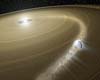 Pasadena CA (SPX) Jan 12, 2006
NASA's Spitzer Space Telescope has spotted what may be comet dust sprinkled around the white dwarf star G29-38, which died approximately 500 million years ago. |
|
|

| The content herein, unless otherwise known to be public domain, are Copyright 1995-2006 - SpaceDaily.AFP and UPI Wire Stories are copyright Agence France-Presse and United Press International. ESA PortalReports are copyright European Space Agency. All NASA sourced material is public domain. Additionalcopyrights may apply in whole or part to other bona fide parties. Advertising does not imply endorsement,agreement or approval of any opinions, statements or information provided by SpaceDaily on any Web page published or hosted by SpaceDaily. Privacy Statement |