|
 |
 |
 |
 |
 |
 |
 |
 |

 |
Astronomers Find First Ever Gamma Ray Clock
Bonn, Germany (SPX) Nov 28, 2006 Astronomers using the H.E.S.S. telescopes have discovered the first ever modulated signal from space in Very High Energy Gamma Rays -- the most energetic such signal ever observed. Regular signals from space have been known since the 1960s, when the first radio pulsar (nicknamed Little Green Men-1 for its regular nature) was discovered. This is the first time a signal has been seen at such high energies -- 100,000 times higher than previously known - and is reported today (24th November) in the journal Astronomy and Astrophysics. The signal comes from a system called LS 5039 which was discovered by the H. E.S.S. team in 2005. LS5039 is a binary system formed of a massive blue star (20 times the mass of the Sun) and an unknown object, possibly a black hole. The two objects orbit each other at very short distance, varying between only 1/5 and 2/5 of the separation of the Earth from the Sun, with one orbit completed every four days. "The way in which the gamma ray signal varies makes LS5039 a unique laboratory for studying particle acceleration near compact objects such as black holes," explained Dr Paula Chadwick from the University of Durham, a British team member of H.E.S.S. Different mechanisms can affect the gamma-ray signal that reaches Earth and by seeing how the signal varies, astronomers can learn a great deal about binary systems such as LS 5039 and also the effects that take place near black holes. As it dives towards the blue-giant star, the compact companion is exposed to the strong stellar 'wind' and the intense light radiated by the star, allowing on the one hand particles to be accelerated to high energies, but at the same time making it increasingly difficult for gamma rays produced by these particles to escape, depending on the orientation of the system with respect to us. The interplay of these two effects is at the root of the complex modulation pattern. The gamma-ray signal is strongest when the compact object (thought to be a black hole) is in front of the star as seen from Earth and weakest when it is behind the star. The gamma rays are thought to be produced as particles which are accelerated in the star's atmosphere (the stellar wind) interact with the compact object. The compact object acts as a probe of the star's environment, showing how the magnetic field varies depending on distance from the star by mirroring those changes in the gamma ray signal. In addition, a geometrical effect adds a further modulation to the flux of gamma-rays observed from the Earth. We know since Einstein derived his famous equation (E=mc2) that matter and energy are equivalent, and that pairs of particles and antiparticles can mutually annihilate to give light. Symmetrically, when very energetic gamma rays meet the light from a massive star, they can be converted into matter (an electron-positron pair in this case). So, the light from the star resembles, for gamma rays, a fog which masks the source of the gamma rays when the compact object is behind the star, partially eclipsing the source. "The periodic absorption of gamma-rays is a nice illustration of the production of matter- antimatter pairs by light, though it also obscures the view to the particle accelerator in this system," said Guillaume Dubus, Astrophysical Laboratory of the Grenoble Observatory, LAOG).
The collaboration:
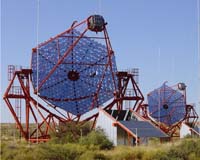
The detector: The H.E.S.S. telescopes detect the faint, short flashes of blueish light which these particles emit (named Cherenkov light, lasting a few billionths of a second), collecting the light with big mirrors which reflect onto extremely sensitive cameras. Each image gives the position on the sky of a single gamma-ray photon, and the amount of light collected gives the energy of the initial gamma ray. Building up the images photon by photon allows H.E.S.S. to create maps of astronomical objects as they appear in gamma rays. The H.E.S.S. telescope array represents a multi-year construction effort by an international team of more than 100 scientists and engineers. The instrument was inaugurated in September 2004 by the Namibian Prime Minister, Theo-Ben Guirab, and its first data have already resulted in a number of important discoveries, including the first astronomical image of a supernova shock wave at the highest gamma-ray energies. The Particle Physics and Astronomy Research Council (PPARC) is the UK's strategic science investment agency. It funds research, education and public understanding in four areas of science - particle physics, astronomy, cosmology and space science. PPARC is government funded and provides research grants and studentships to scientists in British universities, gives researchers access to world-class facilities and funds the UK membership of international bodies such as the European Laboratory for Particle Physics (CERN), the European Southern Observatory (ESO) and the European Space Agency. It also contributes money for the UK telescopes overseas on La Palma, Hawaii, Australia and in Chile, the UK Astronomy Technology Centre at the Royal Observatory, Edinburgh and the MERLIN/VLBI National Facility, which includes the Lovell Telescope at Jodrell Bank observatory. PPARC's Public Understanding of Science and Technology Awards Scheme funds both small local projects and national initiatives aimed at improving public understanding of its areas of science. Community Email This Article Comment On This Article Related Links H.E.S.S. telescopes Understanding Time and Space Understanding Time and Space
 Integration of Planck's Two Instruments
 Paris, France (ESA) Nov 23, 2006
On Monday 20 November, the focal plane units of the two Planck instruments HFI and LFI were integrated into a single assembly. The High Frequency Instrument (HFI) focal plane unit was inserted into the dedicated opening in the centre of the Low Frequency Instrument (LFI) focal plane unit. |
|
|

| The content herein, unless otherwise known to be public domain, are Copyright 1995-2006 - SpaceDaily.AFP and UPI Wire Stories are copyright Agence France-Presse and United Press International. ESA PortalReports are copyright European Space Agency. All NASA sourced material is public domain. Additionalcopyrights may apply in whole or part to other bona fide parties. Advertising does not imply endorsement,agreement or approval of any opinions, statements or information provided by SpaceDaily on any Web page published or hosted by SpaceDaily. Privacy Statement |