|
 |
 |
 |
 |
 |
 |
 |
 |

 |
Astronomers Find Ancient Cities Of Galaxies
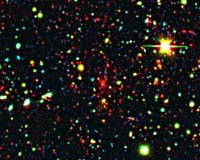
Calgary, Alberta (SPX) Jun 7, 2006 Astronomers using NASA's Spitzer Space Telescope have discovered nearly 300 clusters of galaxies, almost 100 of which are as far as 8 billion to 10 billion light-years away, meaning they date back to a time when the universe was less than half of its present age. Galaxy clusters are the universe's high-density environments, similar to cities on Earth. A single galaxy cluster can contain hundreds of galaxies like the Milky Way. "At this distance, we are literally looking at these galaxies as they were over 8 billion years ago," said co-lead researcher Mark Brodwin, of NASA's Jet Propulsion Laboratory in Pasadena, Calif. "It's like being able to take a picture of Rome during the peak of the Roman Empire." Brodwin and colleagues presented the results at the 208th meeting of the American Astronomical Society in Calgary, Canada. "The oldest and most massive galaxies in the universe live in clusters," said co-author Anthony Gonzalez of the University of Florida in Gainesville. "This sample is exciting because, for the first time, we are able to look at these massive cluster galaxies while they are still forming and better understand when they formed their stars." Astronomers previously have found galaxy clusters at similar distances, but this is the first time so many clusters have been detected so far away. In December 2005 and March 2006, the team reported finding two clusters located 9.1 billion and 8.2 billion light-years away, respectively. This week, they announced the discovery of 290 clusters of varying distances, some of which are referred to as galaxy "groups," because they contain fewer members. The nearly 100 distant clusters and groups belonging to this sample represent a six-fold increase over the number that was previously known. According to the astronomers, the key to their success was a combination of infrared and optical imaging from Spitzer and Kitt Peak National Observatory in Arizona. The distant galaxies making up the clusters light up in the infrared images, but they cannot be distinguished from other galaxies lying in between. By combining the Spitzer images with those from Kitt Peak showing mainly the intervening galaxies, the scientists were able to isolate the distant ones. Their technique made finding the clusters of distant galaxies simply a matter of looking for dense clumps of distant objects. "Distant galaxies show up best in infrared because during the billions of years it takes to reach us, their light expands along with the universe to longer, infrared wavelengths," said team member Peter Eisenhardt of JPL, who led the Spitzer observations. "With Spitzer, we were able to make deep infrared maps thousands of times faster than with the biggest ground-based telescopes, covering enough sky to find these relatively rare clusters," Eisenhardt said. "By adding the deep Kitt Peak optical maps, we could weed out all the galaxies cluttering up the view between us and these distant clusters." So far, the distances to seven of the farthest clusters identified have been confirmed using detailed data from the W.M. Keck Observatory in Mauna Kea, Hawaii. The team will continue to study these ancient galactic cities using Spitzer and NASA's Hubble Space Telescope. They hope to begin tackling two major questions: Just how big are these galactic cities, and how do they grow? Community Email This Article Comment On This Article Related Links Research background Spitzer Kitt Peak Stellar Chemistry, The Universe And All Within It
 Astronomers Find Most Distant Galaxy Cluster Yet
 Calgary, Alberta (SPX) Jun 7, 2006
Astronomers have found the most distant cluster of galaxies to date and possibly the most massive one yet seen at such an early era in the universe. |
|
|

| The content herein, unless otherwise known to be public domain, are Copyright 1995-2006 - SpaceDaily.AFP and UPI Wire Stories are copyright Agence France-Presse and United Press International. ESA PortalReports are copyright European Space Agency. All NASA sourced material is public domain. Additionalcopyrights may apply in whole or part to other bona fide parties. Advertising does not imply endorsement,agreement or approval of any opinions, statements or information provided by SpaceDaily on any Web page published or hosted by SpaceDaily. Privacy Statement |