|
 |
 |
 |
 |
 |
 |
 |
 |

 |
Astronomers Detect Molecular Nitrogen Outside Solar System
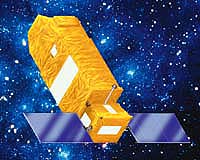
Greenbelt MD (SPX) Jun 10, 2004 NASA's Far Ultraviolet Spectroscopic Explorer (FUSE) satellite, has for the first time detected molecular nitrogen in interstellar space, giving researchers their first detailed look into how the universe's fifth most-abundant element behaves in an environment outside the Solar System. This discovery, made by astronomers at The Johns Hopkins University, Baltimore, promises to enhance understanding not only of the dense regions between the stars, but also of the very origins of life on Earth. "Detecting molecular nitrogen is vital for improved understanding of interstellar chemistry," said David Knauth, a post-doctoral fellow in the Physics and Astronomy Department in the Krieger School of Arts and Sciences at Johns Hopkins and first author of a paper in the June 10 issue of Nature. "And because stars and planets form from the interstellar medium, this discovery will lead to an improved understanding of their formation, as well." Nitrogen is the most prevalent element of Earth's atmosphere. Its molecular form, known as N2, consists of two combined nitrogen atoms. A team of researchers led by Knauth and physics and astronomy research scientist and co-author B-G Andersson continued investigations of N2 that began in the 1970s with the Copernicus satellite. At least 10,000 times more sensitive than Copernicus, FUSE - a satellite-telescope designed at and operated by Johns Hopkins for NASA - allowed the astronomers to probe the dense interstellar clouds where molecular nitrogen was expected to be a dominant player. "Astronomers have been searching for molecular nitrogen in interstellar clouds for decades," said George Sonneborn, FUSE project scientist at NASA Goddard Space Flight Center, Greenbelt, Md. "Its discovery by FUSE will greatly improve our knowledge of molecular chemistry in space." The astronomers faced several challenges along the way, including the fact that they were peering through dusty, dense interstellar clouds that blocked a substantial amount of the star's light. In addition, the researchers confronted a classic Catch-22: Only the brightest stars emitted enough of a signal to allow FUSE to detect molecular nitrogen's presence, but many of those stars were so bright they threatened to damage the satellite's exquisitely-sensitive detectors. HD 124314, a moderately reddened star in the southern constellation of Centaurus, ended up being the first sight line where researchers could verify molecular nitrogen's presence. This discovery is an important step in the complicated process of ascertaining how much molecular nitrogen exists in the interstellar medium and how its presence varies in different environments. "For nitrogen, most models say that a major part of the element should be in the form of N2, but as we had not been able to measure this molecule, it's been very hard to test whether those models and theories are right or not. The big deal here is that now we have a way to test and constrain those models," Andersson said. Community Email This Article Comment On This Article Related Links FUSE Mission SpaceDaily Search SpaceDaily Subscribe To SpaceDaily Express Nuclear Space Technology at Space-Travel.com
 A Tale Of Two Populations
 Paranal, Chile (SPX) Mar 16, 2005
On the basis of stellar spectra totalling more than 200 hours of effective exposure time with the 8.2-m VLT Kueyen telescope at Paranal (Chile), a team of astronomers [1] has made a surprising discovery about the stars in the giant southern globular cluster Omega Centauri. |
|
|

| The content herein, unless otherwise known to be public domain, are Copyright 1995-2006 - SpaceDaily.AFP and UPI Wire Stories are copyright Agence France-Presse and United Press International. ESA PortalReports are copyright European Space Agency. All NASA sourced material is public domain. Additionalcopyrights may apply in whole or part to other bona fide parties. Advertising does not imply endorsement,agreement or approval of any opinions, statements or information provided by SpaceDaily on any Web page published or hosted by SpaceDaily. Privacy Statement |