|
 |
 |
 |
 |
 |
 |
 |
 |

 |
Astronauts Test Shuttle Repair Platform In First Spacewalk
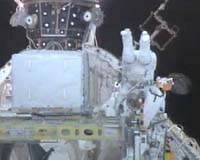
Houston TX (AFP) Jul 10, 2006 Discovery astronauts Piers Sellers and Mike Fossum perched on the space shuttle's elongated robotic arm Saturday during their key first spacewalk to try out the beam as a platform for possible future shuttle repairs. NASA officials, meanwhile, appeared optimistic that Discovery would be declared free of any damage that would require in-orbit repairs during the current mission. The spacewalk was part of NASA's intense efforts to improve shuttle safety three years after the Columbia tragedy. Sellers strapped his boots to a pole at the tip of a 15-meter (50-foot) long boom added to the equally long robotic arm, and moved around to test its stability. "It gets easier as you go along doing all these tasks on the end of this skinny little pole," he told mission control at Johnson Space Center. "A little practice makes perfect, or at least adequate." Fossum then joined Sellers at the end of the boom to see if it could support two astronauts. The platform would allow them to make repairs on otherwise hard-to-reach parts of the shuttle. "So far, these tests have shown much better rigidity than had been expected," NASA spokesman Kelly Humphries said during the televised simulation. As they dangled on the beam side-by-side above Discovery, which is docked to the space station, the astronauts marveled at the view about 350 kilometers (220 miles) from Earth during their seven and a half hour spacewalk. "Look at the Moon coming up over the port wing. That's beautiful," Fossum said. As he looked down at the planet below, Sellers said, "Oh my goodness, it's a beautiful day in Ireland." Mission specialists Lisa Nowak and Stephanie Wilson controlled the robotic arm, keeping the astronauts well above the shuttle for the test. The first of three planned spacewalks could have coincidentally served as a practice run for a repair in the current mission. Analysts were to work overnight to examine two areas on the shuttle that could be of potential concern, including a gap filler sticking out from between thermal tiles in Discovery's underside. "The only way to access that location is using the boom," Steve Poulos, the shuttle program manager, told reporters. But Poulos said analysts likely would determine that the gap filler - and an insulating blanket sticking out in front of a window - do not pose a risk for Discovery's return to Earth. NASA wants to resume regular shuttle missions to finish the ISS before the fleet is retired in 2010, but first it must show it has made spaceflight safer. The ability to make in-orbit repairs is among several efforts by the space agency to prevent another tragedy. New repair techniques were tested in the first post-Columbia flight last year. On their third spacewalk Wednesday, the astronauts will test repairs on pre-damaged samples of reinforced carbon-carbon, a composite material used on the shuttle's wing leading edges as a heat shield. Proving that "we can repair RCC in flight is pretty valuable to the program," Fossum told CBS radio. Columbia's demise was caused by foam insulation that peeled off its external fuel tank and pierced its heat shield during liftoff, dooming its return to Earth on Feb. 1, 2003. NASA has since made several fuel tank modifications to limit the size of debris during blastoff. Officials said they were pleased with the performance of Discovery's fuel tank during liftoff, saying it shed small pieces of debris as expected but too late into ascent to cause concern. If NASA concludes, however, that the shuttle suffered irreparable damage, the astronauts would take refuge inside the space station and wait for a rescue mission.
Source: Agence France-Presse Community Email This Article Comment On This Article Related Links Shuttle at NASA Space Shuttle News at Space-Travel.Com
 Discovery Looks Good For Earth Return
 Washington DC (SPX) Jul 10, 2006
NASA officials said Sunday that shuttle Discovery shows no signs of damage that could threaten its return to Earth on July 16 or 17, and the problem areas identified so far are not considered serious. |
|
|

| The content herein, unless otherwise known to be public domain, are Copyright 1995-2006 - SpaceDaily.AFP and UPI Wire Stories are copyright Agence France-Presse and United Press International. ESA PortalReports are copyright European Space Agency. All NASA sourced material is public domain. Additionalcopyrights may apply in whole or part to other bona fide parties. Advertising does not imply endorsement,agreement or approval of any opinions, statements or information provided by SpaceDaily on any Web page published or hosted by SpaceDaily. Privacy Statement |