|
 |
 |
 |
 |
 |
 |
 |
 |

 |
Astronauts Test Shuttle Repair Material In Final Spacewalk
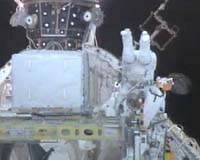
Houston, Texas (AFP) Jul 12, 2006 Two spacewalking Discovery astronauts on Wednesday tested shuttle repair material created after the Columbia disaster as part of NASA's efforts to prevent another tragedy. In the last of three spacewalks, astronauts Piers Sellers and Mike Fossum floated into Discovery's payload bay to paste a sealant on pre-damaged heat shield samples to test the material's performance in zero gravity. The astronauts used a caulk gun and spatula to cover the samples with the material, whose texture they compared to peanut butter, soft putty and mud. "It's now behaving like drying mud," Sellers said during the spacewalk, which lasted more than seven hours. "On the whole, the material is behaving very well," he said later. In the spacewalk's first task, Sellers stood at the tip of the International Space Station's robotic arm to record images of Discovery's leading wing edges with an infrared camera. The shuttle docked with the ISS last week. Columbia's thermal protection was cracked by a piece of foam insulation that peeled off its external fuel tank during liftoff, causing the shuttle to break into a ball of fire as it returned to Earth in February 2003. Since then, NASA has made modifications to the massive orange fuel tank to reduce the amount of debris it loses during launch, and has tested in-orbit repair techniques in the two shuttle missions since the Columbia accident. After examining hundreds of images of Discovery's heat shield, the US space agency declared the shuttle free of damage that could endanger its return to Earth on Monday. NASA extended the mission by a day, to 13 days, in order to squeeze in the third spacewalk. Although the sealant was tested in a laboratory, officials said they need to see how it reacts in space. Being able to "prove that we can repair (the heat shield) in flight is pretty valuable to the program," Fossum said in a US radio interview last week. In their first excursion, the duo tested the stability of a boom extension on the shuttle's robotic arm for possible future repairs in hard-to-reach areas. NASA found that the boom showed promise as a possible work platform. The 30-meter-long (100-foot-long) platform, combined with a successful test of the sealant Wednesday, would add to NASA's "tool box" in the event of damage during future shuttle missions, lead flight director Tony Ceccacci said. While NASA wants to give astronauts the ability to fix their vessel in orbit, the US space agency has worked intensely over the past three years to protect the shuttle from being damaged during liftoff. The focus before last week's launch had been on the shuttle's troublesome external fuel tank, which has perplexed NASA since the Columbia accident, which killed seven astronauts. A large chunk of foam peeled off again in the first post-Columbia flight last year, though without hitting the spaceship. NASA grounded the 25-year-old shuttle fleet until now, however, to make more changes to the tank. Discovery's July 4 launch had been controversial, as NASA administrator Michael Griffin decided to go ahead with the mission despite calls by his chief safety officer and head engineer for a six-month delay to make further modifications to the foam insulation. Griffin had predicted that the fuel tank would not lose large pieces of foam. Officials have described the tank's performance last week as "outstanding." This time, it shed small pieces of debris as expected, but too late into liftoff to cause concern. NASA wants to show a marked improvement in safety since the Columbia accident in order to move ahead with plans to launch 16 shuttle missions by 2010 to finish building the ISS.
Source: Agence France-Presse Community Email This Article Comment On This Article Related Links the missing link Space Shuttle News at Space-Travel.Com
 Shuttle Mission Day Six Marked By Calm Routine
 Washington DC (SPX) Jul 12, 2006
The crews of Discovery and the International Space Station spent Tuesday unloading more of the 7,000 pounds of clothing, food and other supplies brought by the shuttle in the Italian-built multi-purpose Leonardo cargo module. |
|
|

| The content herein, unless otherwise known to be public domain, are Copyright 1995-2006 - SpaceDaily.AFP and UPI Wire Stories are copyright Agence France-Presse and United Press International. ESA PortalReports are copyright European Space Agency. All NASA sourced material is public domain. Additionalcopyrights may apply in whole or part to other bona fide parties. Advertising does not imply endorsement,agreement or approval of any opinions, statements or information provided by SpaceDaily on any Web page published or hosted by SpaceDaily. Privacy Statement |