|
 |
 |
 |
 |
 |
 |
 |
 |

 |
Astronauts Start Experiments On China Space Flight As Nation Rejoices
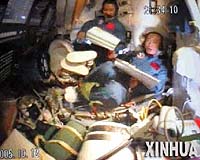
Jiuquan, China (AFP) Oct 13, 2005 Astronauts on China's second manned space flight conducted experiments and tested their life support systems Thursday as the second day of the mission was beamed to an entranced public. All systems on Shenzhou VI were working normally after a successful launch into orbit from the Jiuquan Satellite Launch Centre in Inner Mongolia on Wednesday, a spokesman at the mission control centre in Beijing said. "The astronauts will carry out many space-based scientific experiments, including movement experiments inside the craft, work efficiency tests and the testing of the environmental control and life support systems inside the craft," the spokesman said in a statement. "These experiments will form the technical basis of our future manned space program." Astronauts Fei Junlong and Nie Haisheng moved about the spaceship on the second day of the mission which has opened a new chapter in China's ambitious drive to become a global space power. The manned flight is the second for China after an October 2003 mission made the country the third in the world -- after the former Soviet Union and the United States -- to send a man into space. During the 21-hour maiden flight, lone astronaut Yang Liwei never left his seat in the re-entry capsule nor take off his space suit. In contrast, Fei and Nie have already left the re-entry capsule and entered the orbital capsule, shedding their bulky suits and donning ordinary work clothes so they can move around easily. After five days in space, the two astronauts are scheduled to land in the re-entry capsule on Monday in China's Inner Mongolia. But Shenzhou VI's orbital capsule is expected to continue to move around Earth for months. The astronauts have successfully fired rockets to adjust the craft's altitude, ensuring it remains in its pre-planned orbit -- which is crucial for its return to Earth, the mission control spokesman said. Premier Wen Jiabao hailed the historic event as a success after watching from the launch pad on Wednesday and the mission has captivated the nation with millions of Chinese watching the launch on television. Dispelling concerns that China could use space for military purposes, Wen said the purpose of the mission was to conduct experiments "entirely for peaceful purposes." The Chinese government also hopes to use the manned space program to invigorate patriotism and instill a curiosity in science and technology amongst China's largely agrarian population. "We watched the launch in school, everyone was excited," said nine-year-old Jiang Yuchuan at Beijing's Fangcaodi elementary school. "We are learning about space and rockets now." China's state press gushed over the launch, with the leading People's Daily saying its success embodied "China's special character," its technical progress, national strength and international competitiveness. The English-language China Daily said, "Yesterday's successful launch ... has again ushered in a time of national pride and celebration for the whole Chinese nation." "It is hoped the can-do spirit, which has facilitated the success of our manned space mission, will inspire the entire nation to aim higher and build a more prosperous and harmonious society." State television showed the families of the astronauts at mission control in Beijing speaking with the two former fighter jet pilots, including Nie's daughter singing "Happy Birthday" to her father on his 41st birthday. "We all feel very proud of you... May you carry out the task entrusted to you by the motherland and return smoothly," said Wang Jie, Fei's wife. Community Email This Article Comment On This Article Related Links SpaceDaily Search SpaceDaily Subscribe To SpaceDaily Express The Chinese Space Program - News, Policy and Technology China News from SinoDaily.com
 Taikonauts On Moon A Far Off Dream For China Yet
 Beijing (XNA) Jan 05, 2006
A one-year lunar fly-by mission may start in April 2007 in China, but a manned flight to the Earth's neighbour may be a long way away, a chief lunar exploration scientist said last night. |
|
|

| The content herein, unless otherwise known to be public domain, are Copyright 1995-2006 - SpaceDaily.AFP and UPI Wire Stories are copyright Agence France-Presse and United Press International. ESA PortalReports are copyright European Space Agency. All NASA sourced material is public domain. Additionalcopyrights may apply in whole or part to other bona fide parties. Advertising does not imply endorsement,agreement or approval of any opinions, statements or information provided by SpaceDaily on any Web page published or hosted by SpaceDaily. Privacy Statement |